O Levels Chemistry (5070)•5070/11/O/N/23
Explanation
Metal extraction primarily involves reduction Steps:
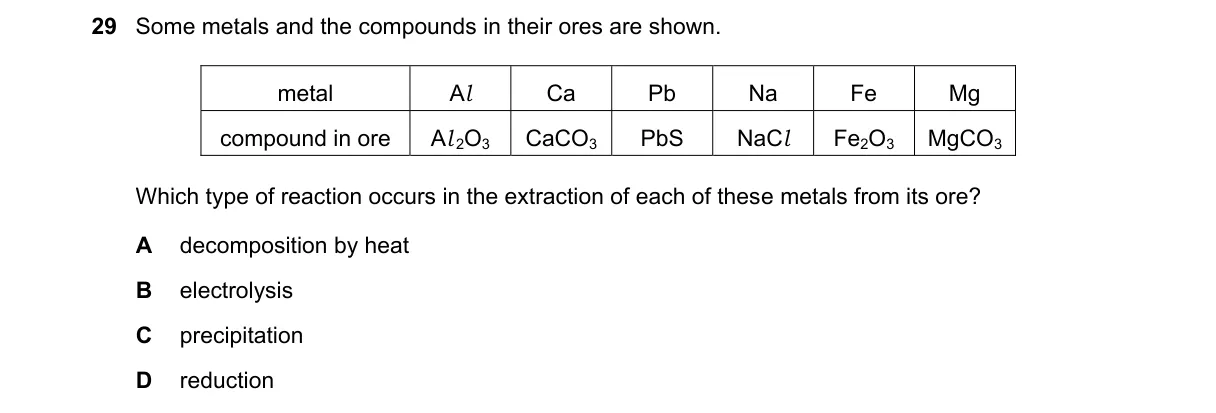
- Examine ore compounds: Al2O3 (oxide), CaCO3 (carbonate), PbS (sulfide), NaCl (chloride), Fe2O3 (oxide), MgCO3 (carbonate).
- Note carbonates (CaCO3, MgCO3) undergo thermal decomposition to oxides; PbS is roasted to oxide.
- Oxides and chloride are then converted to metals via reduction: electrolysis for reactive metals (Al, Ca, Na, Mg), carbon reduction for less reactive (Fe, Pb).
- Conclude the core process for all is reduction of metal ions to elemental metal.
Why D is correct:
- Reduction defines metal extraction, where ores (metal compounds) lose oxygen or gain electrons to yield pure metal, as in Fe2O3 + 3CO → 2Fe + 3CO2.
Why the others are wrong:
- A: Decomposition by heat applies only to carbonates like CaCO3 → CaO + CO2 as a preprocessing step, not the full extraction.
- B: Electrolysis is a reduction method but limited to highly reactive metals like Al from Al2O3, not universal.
- C: Same as B; electrolysis suits Na from NaCl but not Fe or Pb.
Final answer: D
Topic: Extraction of metals
Practice more O Levels Chemistry (5070) questions on mMCQ.me