O Levels Chemistry (5070)•5070/11/O/N/23
Explanation
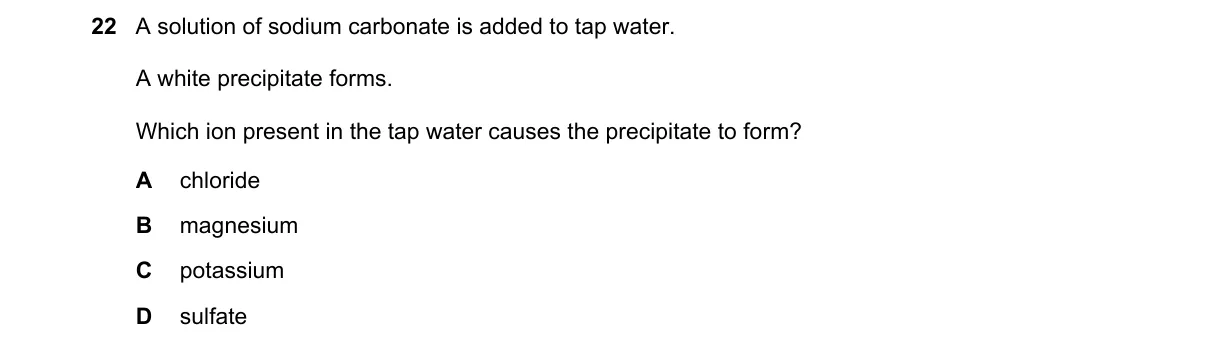
Precipitation of Insoluble Magnesium Carbonate
Steps:
- Sodium carbonate (Na₂CO₃) dissociates to provide CO₃²⁻ ions in solution.
- Tap water contains dissolved ions, including potential hardness contributors like Mg²⁺.
- CO₃²⁻ reacts with Mg²⁺ to form MgCO₃, an insoluble white precipitate.
- Other common tap water ions do not form insoluble carbonates under these conditions.
Why B is correct:
- Magnesium ions (Mg²⁺) form magnesium carbonate (MgCO₃), which is insoluble in water per solubility rules for Group 2 carbonates.
Why the others are wrong:
- A. Chloride ions (Cl⁻) do not react with CO₃²⁻ to form any precipitate; sodium chloride is highly soluble.
- C. Potassium ions (K⁺) form soluble potassium carbonate (K₂CO₃) with CO₃²⁻.
- D. Sulfate ions (SO₄²⁻) do not form an insoluble compound with CO₃²⁻; sodium sulfate is soluble.
Final answer: B
Topic: Identification of ions and gases
Practice more O Levels Chemistry (5070) questions on mMCQ.me