O Levels Chemistry (5070)•5070/12/O/N/22
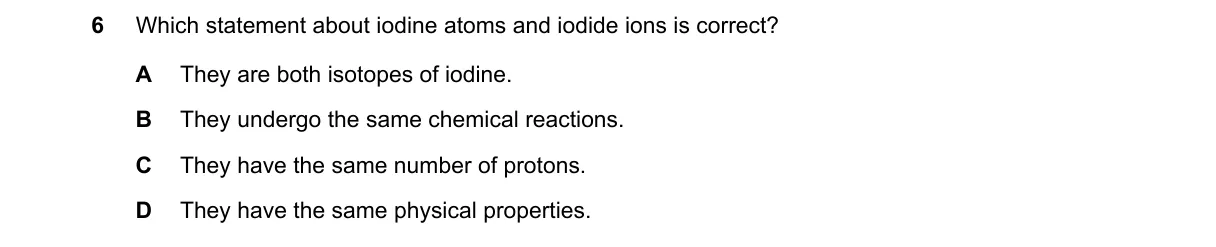
Explanation
Iodine atoms and ions differ by electrons but share protons
Steps:
- Identify iodine atom as neutral with 53 protons, 53 electrons, and typically 74 neutrons.
- Recognize iodide ion (I⁻) as iodine atom gaining one electron, resulting in 53 protons and 54 electrons.
- Confirm both have atomic number 53, meaning identical proton count.
- Distinguish that ionization changes charge and electron count but not protons or neutrons.
Why C is correct:
- Atomic number defines the element; iodine's atomic number 53 means all its atoms and ions have exactly 53 protons.
Why the others are wrong:
- A: Isotopes have the same protons but different neutrons; atom and ion differ in electrons, not neutrons.
- B: Iodide ions, being charged, form different compounds (e.g., salts) than neutral atoms.
- D: Ions have distinct physical properties like higher solubility in water due to charge.
Final answer: C
Topic: Atomic structure and the Periodic Table
Practice more O Levels Chemistry (5070) questions on mMCQ.me