O Levels Chemistry (5070)•5070/12/O/N/22
Explanation
Elements Forming Multiple Oxides
Steps:
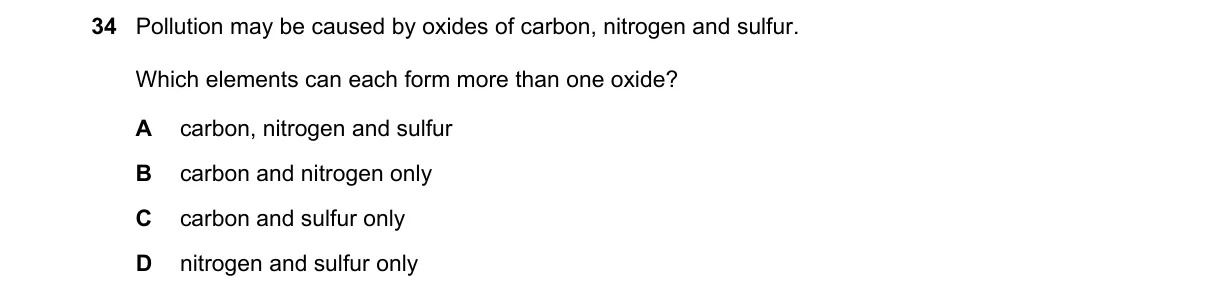
- Recall common oxides: Carbon forms CO (carbon monoxide) and CO₂ (carbon dioxide).
- Nitrogen forms multiple oxides like N₂O (nitrous oxide), NO (nitric oxide), and NO₂ (nitrogen dioxide).
- Sulfur forms SO₂ (sulfur dioxide) and SO₃ (sulfur trioxide).
- Confirm all three elements have more than one oxide, matching option A.
Why A is correct:
- Carbon, nitrogen, and sulfur each exhibit variable oxidation states (e.g., C in +2 and +4; N in +1, +2, +4, +5; S in +4 and +6), allowing formation of multiple oxides.
Why the others are wrong:
- B omits sulfur, which forms SO₂ and SO₃.
- C omits nitrogen, which forms N₂O, NO, NO₂, and more.
- D omits carbon, which forms CO and CO₂.
Final answer: A
Topic: Oxides
Practice more O Levels Chemistry (5070) questions on mMCQ.me