O Levels Chemistry (5070)•5070/12/O/N/22
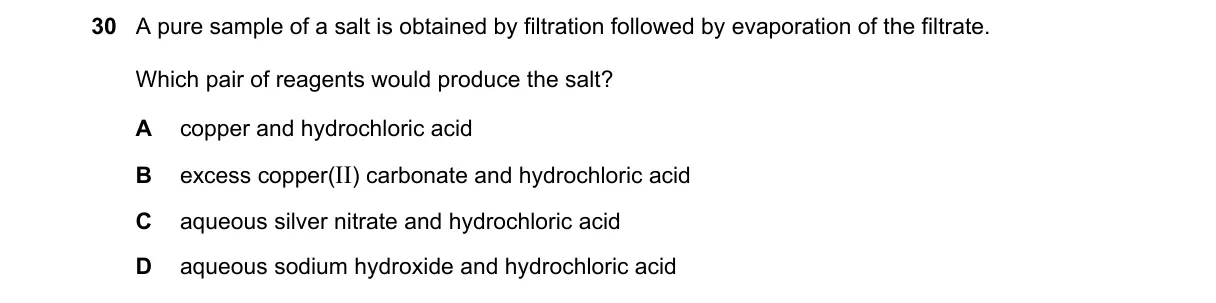
Explanation
Excess insoluble reactant enables impurity removal by filtration
Steps:
- Identify process: Reaction produces soluble salt in solution with insoluble residue; filter residue, evaporate filtrate for pure salt.
- Analyze reactions: Check for insoluble byproduct or excess that requires filtration.
- Evaluate pairs: Determine if filtration step yields pure soluble salt solution.
- Select match: Choose option with excess insoluble reagent forming filterable impurity.
Why B is correct:
- Excess CuCO₃ reacts incompletely with HCl (CuCO₃ + 2HCl → CuCl₂ + H₂O + CO₂), leaving unreacted insoluble CuCO₃ as residue; filtration removes it, evaporation of CuCl₂ filtrate yields pure salt.
Why the others are wrong:
- A: Stoichiometric CuCO₃ + HCl fully dissolves to CuCl₂ solution; no insoluble residue, filtration unnecessary.
- C: AgNO₃(aq) + HCl(aq) → AgCl(s) + HNO₃(aq); filtration removes salt (AgCl), filtrate evaporation yields acid, not salt.
- D: NaOH(aq) + HCl(aq) → NaCl(aq) + H₂O; fully soluble, no residue, filtration irrelevant.
Final answer: B
Topic: Preparation of salts
Practice more O Levels Chemistry (5070) questions on mMCQ.me