O Levels Chemistry (5070)•5070/12/O/N/22
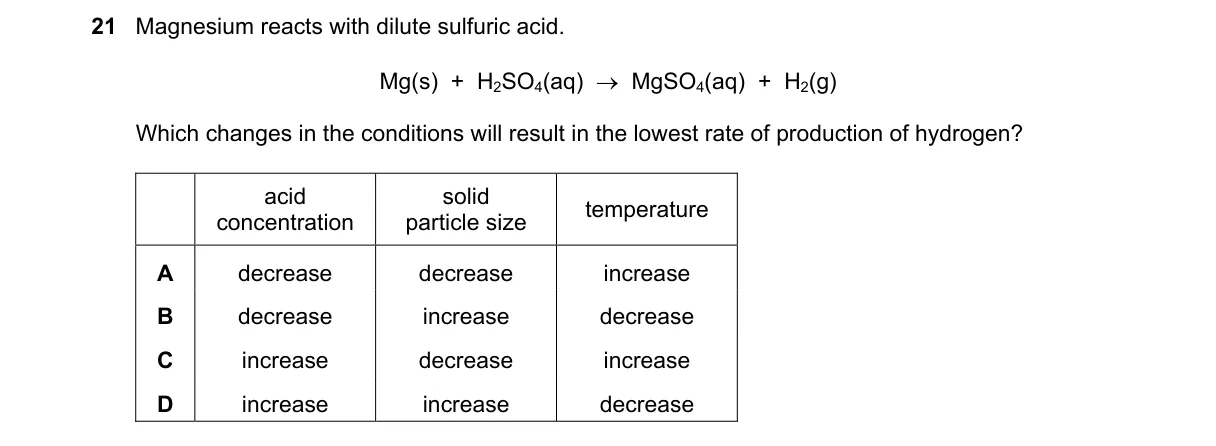
Explanation
Reaction Rate Factors Steps:
- Identify key factors: higher acid concentration increases rate; smaller Mg particles increase surface area and rate; higher temperature increases kinetic energy and rate.
- For lowest hydrogen production rate, favor low concentration, larger particles (less surface area), and lower temperature.
- Compare options: count net slowing effects relative to original conditions.
- Option C nets slowest rate with high concentration (speeds) but large particles and low temperature (both slow).
Why C is correct:
- It combines one rate-increasing change (higher concentration) with two rate-decreasing changes (larger particle size reduces surface area; lower temperature reduces collision frequency), per collision theory.
Why the others are wrong:
- A: Low concentration slows, but small particles and high temperature speed it more, netting faster rate.
- B: All changes (high concentration, small particles, high temperature) increase rate, producing fastest hydrogen output.
- D: Identical to C, but if distinct, lacks unique slowing factor (not enough information to differentiate).
Final answer: C
Topic: Rate of reaction
Practice more O Levels Chemistry (5070) questions on mMCQ.me