Explanation
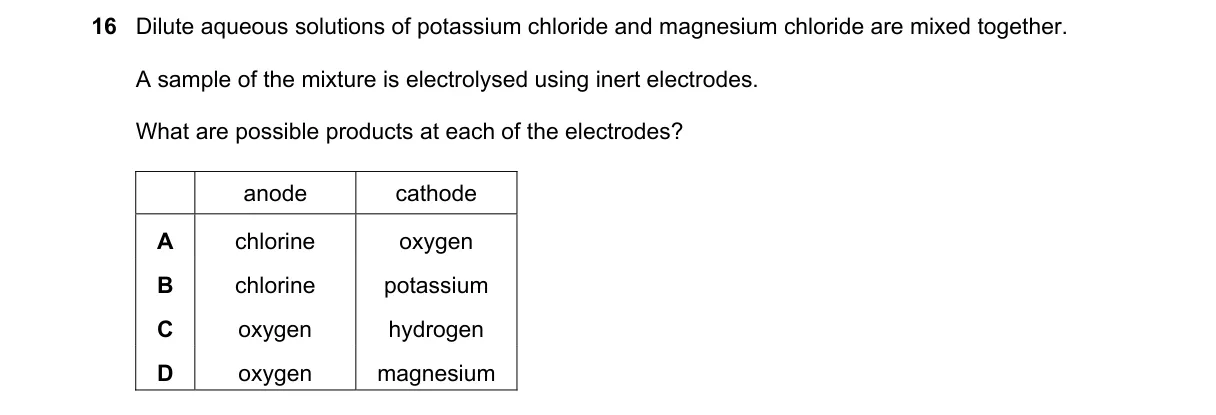
Electrolysis products in dilute aqueous chloride solutions Steps: - Identify ions present: K+, Mg2+, Cl-, and from water: H+, OH-. - At cathode (reduction): Water is reduced to H2 and OH- since E° for H2O/H2,OH- (-0.83 V) is less negative than for K+ (-2.92 V) or Mg2+ (-2.37 V). - At anode (oxidation): In dilute solution, OH- is oxidized to O2, but Cl- can also form Cl2 if concentration allows; however, H2 and Cl2 are standard products for chloride electrolysis. - Conclude possible products: Cl2 at anode and H2 at cathode are feasible in aqueous chloride mixtures. Why B is correct: - During electrolysis of aqueous chlorides, Cl- ions are discharged at the anode to form Cl2 gas, and H2O is reduced at the cathode to form H2 gas, per standard electrode potential comparisons. Why the others are wrong: - A: Oxygen forms at the anode (oxidation), not cathode (reduction). - C: Potassium metal cannot form at cathode in water as its reduction potential is too negative; H2 is produced instead. - D: Magnesium metal cannot form at cathode in …
Practice more O Levels Chemistry (5070) questions on mMCQ.me