O Levels Chemistry (5070)•5070/11/O/N/22
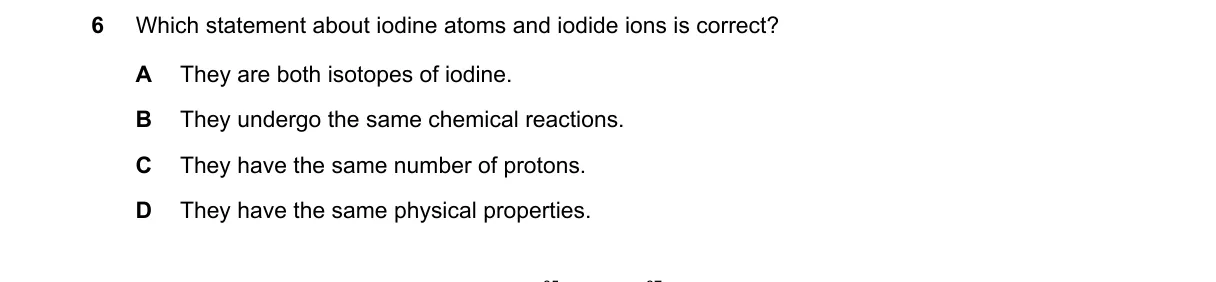
Explanation
Atomic vs. Ionic Identity in Iodine
Steps:
- Iodine atom (I) is neutral with 53 protons and 53 electrons; iodide ion (I⁻) has 53 protons and 54 electrons.
- Both share the same atomic number (53), defining them as iodine.
- Isotopes differ in neutrons, not electrons; ions differ in electrons, not protons.
- Evaluate options: only proton count remains identical.
Why C is correct:
- The number of protons (atomic number) identifies the element; all iodine species, including atoms and ions, have 53 protons by definition.
Why the others are wrong:
- A: Isotopes have the same protons but different neutrons; atoms and ions differ in electrons, not neutrons.
- B: Iodide ions react differently due to their negative charge, forming ionic compounds unlike neutral atoms.
- D: Iodide ions are larger and more soluble than atoms, altering physical properties like size and state.
Final answer: C
Topic: Atomic structure and the Periodic Table
Practice more O Levels Chemistry (5070) questions on mMCQ.me