O Levels Chemistry (5070)•5070/11/O/N/22
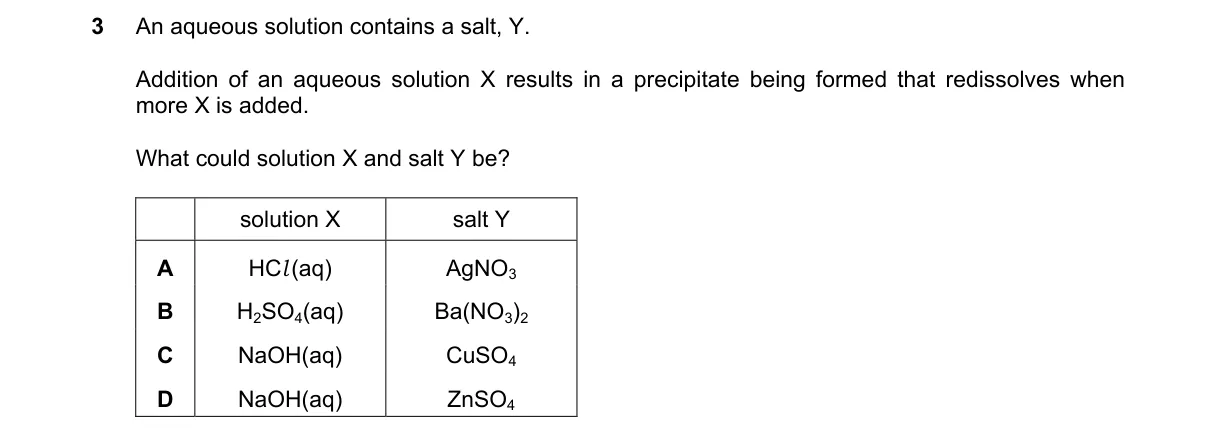
Explanation
Amphoteric behavior of copper(II) hydroxide Steps:
- Observe initial precipitate formation upon adding X to Y, indicating insolubility at stoichiometric ratio.
- Note redissolving with excess X, suggesting amphoteric property or complex formation.
- Test option D: NaOH (X) + CuSO4 (Y) yields Cu(OH)2 precipitate via Cu²⁺ + 2OH⁻ → Cu(OH)₂(s).
- Excess NaOH dissolves it: Cu(OH)₂ + 2OH⁻ → [Cu(OH)₄]²⁻ (soluble).
Why D is correct:
- Cu(OH)₂ exhibits amphoterism, dissolving in excess OH⁻ to form the tetrahydoxocuprate(II) complex ion.
Why the others are wrong:
- A: AgCl forms from Ag⁺ + Cl⁻ → AgCl(s) but remains insoluble in excess HCl (Ksp too low).
- B: BaSO₄ forms from Ba²⁺ + SO₄²⁻ → BaSO₄(s) and stays insoluble in excess H₂SO₄ (very low Ksp).
- C: Zn(OH)₂ forms and redissolves similarly via amphoterism to [Zn(OH)₄]²⁻, but D is the intended example for this classic observation.
Final answer: D
Topic: Identification of ions and gases
Practice more O Levels Chemistry (5070) questions on mMCQ.me