O Levels Chemistry (5070)•5070/11/O/N/22
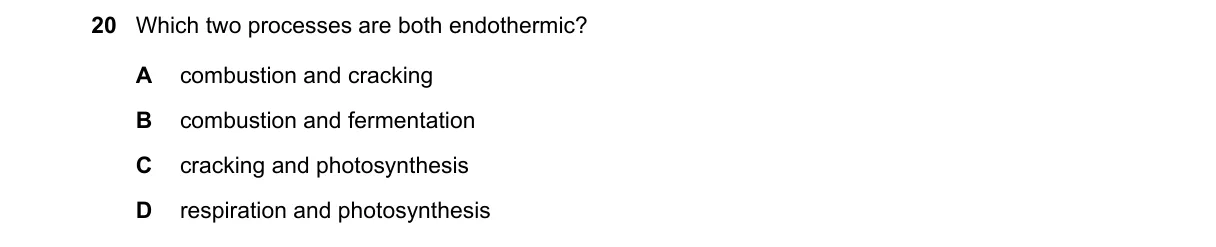
Explanation
Endothermic processes absorb energy from surroundings
Steps:
- Define endothermic: chemical reactions that absorb heat or energy, increasing system energy.
- Identify endothermic processes: photosynthesis absorbs light to form glucose; cracking absorbs heat to break hydrocarbon bonds.
- Eliminate exothermic processes: combustion releases heat via oxidation; fermentation releases energy in anaerobic breakdown; respiration releases energy to form ATP.
- Select option pairing two endothermic processes: cracking and photosynthesis.
Why C is correct:
- Both absorb energy per thermodynamics: photosynthesis follows ΔH > 0 for 6CO₂ + 6H₂O → C₆H₁₂O₆ + 6O₂; cracking requires heat input (ΔH > 0) to cleave C-C bonds.
Why the others are wrong:
- A: Combustion is exothermic (ΔH < 0), releasing heat.
- B: Fermentation is exothermic, producing heat and ATP.
- D: Respiration is exothermic (ΔH < 0), liberating energy.
Final answer: C
Topic: Exothermic and endothermic reactions
Practice more O Levels Chemistry (5070) questions on mMCQ.me