O Levels Chemistry (5070)•5070/11/O/N/22
Explanation
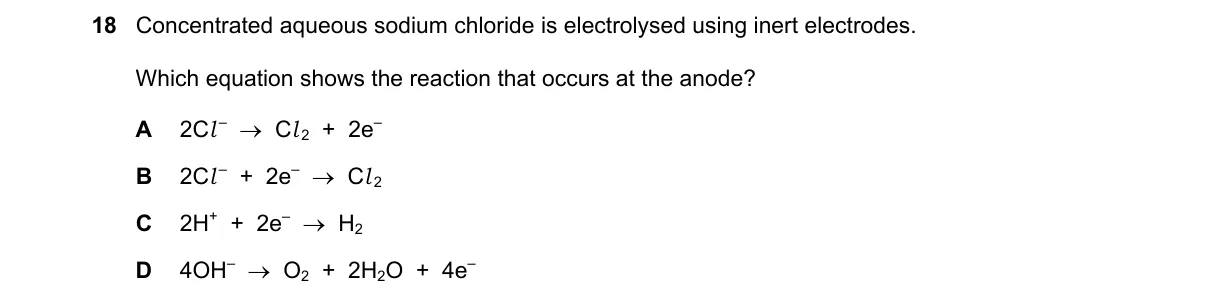
Anode reaction in concentrated NaCl electrolysis
Steps:
- Anode is site of oxidation, releasing electrons.
- In concentrated aqueous NaCl, anions present are Cl⁻ (from NaCl) and OH⁻ (from water).
- Concentrated Cl⁻ makes its oxidation (lower potential, 1.36 V) more likely than water's (1.23 V but overpotential favors Cl⁻).
- Thus, 2Cl⁻ discharge to Cl₂ occurs.
Why A is correct:
- Matches oxidation half-reaction for Cl⁻ ions, as per standard electrode potentials where Cl₂/Cl⁻ (1.36 V) is discharged preferentially in high [Cl⁻].
Why the others are wrong:
- B: Water oxidation to O₂ occurs in dilute NaCl, not concentrated.
- C: Cathode reduction of H⁺ to H₂, not anode oxidation.
- D: OH⁻ oxidation to O₂ in basic conditions or dilute solutions, not concentrated Cl⁻.
Final answer: A
Topic: Electrolysis
Practice more O Levels Chemistry (5070) questions on mMCQ.me