O Levels Chemistry (5070)•5070/12/O/N/21
Explanation
Anode Reactions in Hall-Héroult Process
Steps:
- In electrolysis, the positive electrode (anode) is the site of oxidation reactions, where electrons are lost.
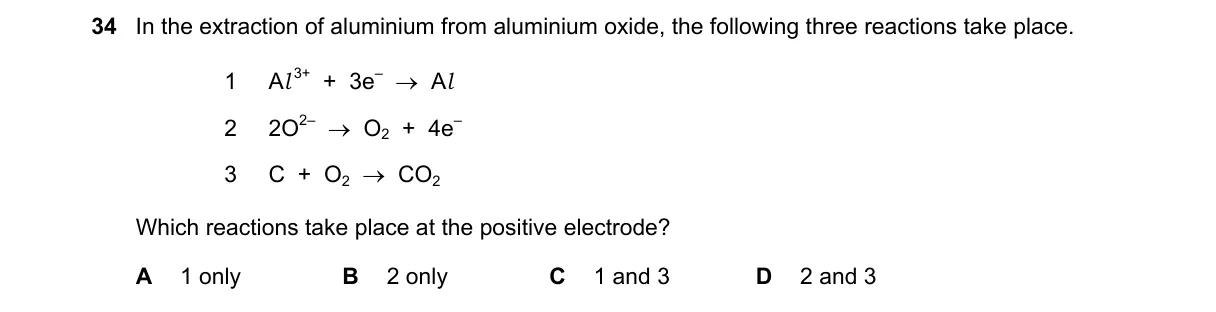
- Reaction 1 (Al³⁺ + 3e⁻ → Al) is a reduction (gain of electrons), so it occurs at the cathode.
- Reaction 2 (2O²⁻ → O₂ + 4e⁻) is an oxidation (loss of electrons from oxide ions), so it occurs at the anode.
- Reaction 3 (C + O₂ → CO₂) involves the carbon anode reacting with O₂ produced in reaction 2, consuming the anode material at the positive electrode.
Why D is correct:
- Reactions 2 and 3 both occur at the anode, as defined by oxidation processes in the electrolytic cell (Faraday's laws of electrolysis).
Why the others are wrong:
- A: Reaction 1 is reduction at the cathode, not anode.
- B: Omits reaction 3, which is the anode's consumption by CO₂ formation.
- C: Includes reaction 1 (cathode) and excludes reaction 2 (anode oxidation).
Final answer: D
Topic: Extraction of metals
Practice more O Levels Chemistry (5070) questions on mMCQ.me