O Levels Chemistry (5070)•5070/12/O/N/21
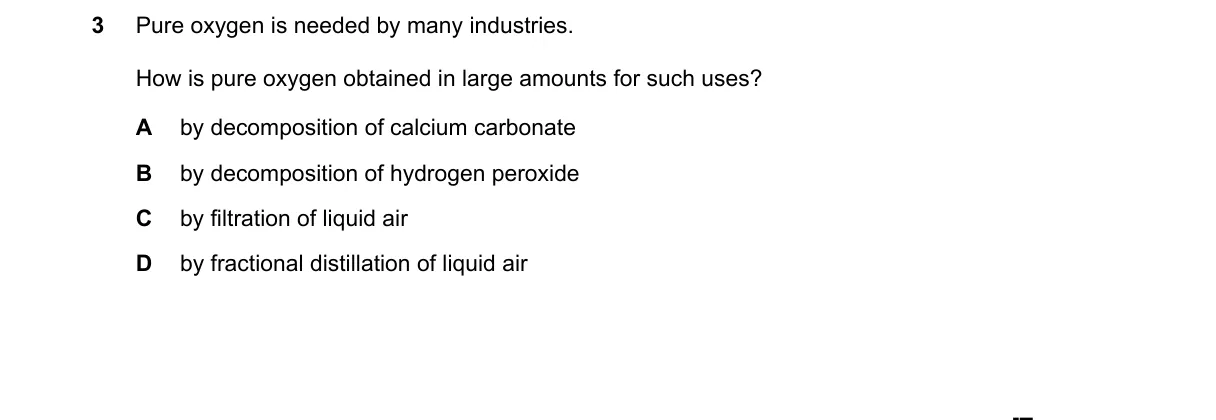
Explanation
Industrial Oxygen Production via Air Separation
Steps:
- Air is a mixture of gases, with oxygen at about 21% by volume, making it the primary source for large-scale extraction.
- To separate, air is cooled and liquefied under high pressure and low temperature.
- Liquid air is then fractionally distilled, exploiting boiling point differences: nitrogen boils at -196°C and evaporates first, leaving oxygen (boiling at -183°C) behind.
- This yields high-purity oxygen (up to 99%) in industrial quantities.
Why D is correct:
- Fractional distillation separates liquid air components based on boiling points, as defined by Raoult's law for ideal mixtures, efficiently producing tons of pure oxygen daily for medical and industrial uses.
Why the others are wrong:
- A: Calcium carbonate decomposition yields carbon dioxide (CaCO₃ → CaO + CO₂), not oxygen.
- B: Hydrogen peroxide decomposition (2H₂O₂ → 2H₂O + O₂) produces oxygen but only in small lab-scale amounts, not industrially viable.
- C: Filtration removes particles from air but cannot separate gases like oxygen from nitrogen.
Final answer: D
Topic: Separation and purification
Practice more O Levels Chemistry (5070) questions on mMCQ.me