O Levels Chemistry (5070)•5070/12/O/N/21
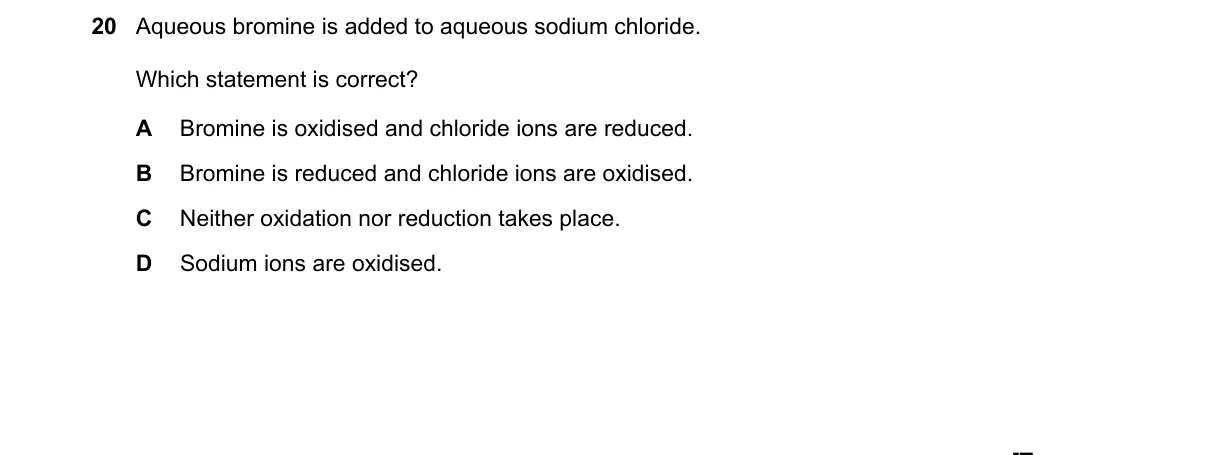
Explanation
No redox reaction between Br₂ and Cl⁻
Steps:
- Recall standard electrode potentials: E°(Cl₂/Cl⁻) = +1.36 V > E°(Br₂/Br⁻) = +1.07 V.
- Determine oxidizing strength: Cl₂ is stronger oxidant than Br₂, so Br₂ cannot oxidize Cl⁻ to Cl₂.
- Check for displacement: No reaction as Br₂ is weaker halogen, cannot displace Cl⁻ from NaCl(aq).
- Conclude: Mixture remains unchanged, no electron transfer.
Why C is correct:
- Redox requires electron transfer; here, electrode potentials show no spontaneous reaction per Nernst equation.
Why the others are wrong:
- A: Cl⁻ cannot oxidize Br₂ as Cl⁻ is weaker reducing agent.
- B: Br₂ cannot oxidize Cl⁻ due to lower reduction potential.
- D: Na⁺ is spectator ion, not involved in redox.
Final answer: C
Topic: Group VII properties
Practice more O Levels Chemistry (5070) questions on mMCQ.me