Explanation
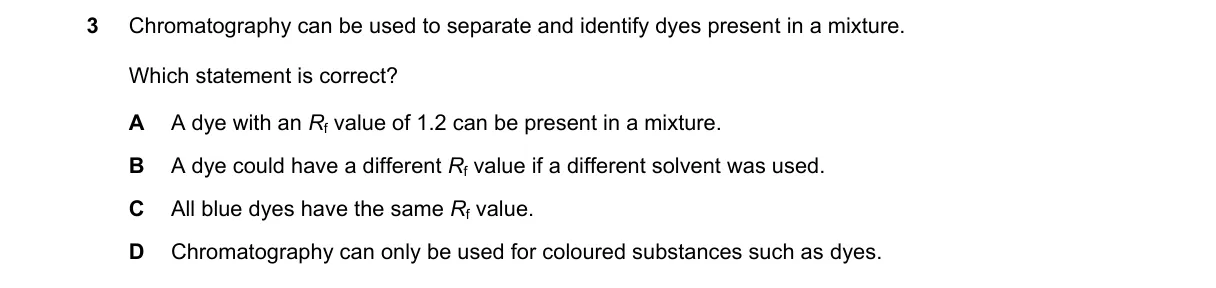
Rf values in chromatography depend on the mobile phase (solvent) Steps: - Recall that Rf = (distance traveled by dye) / (distance traveled by solvent front), measuring dye solubility in solvent versus adsorption on stationary phase. - Note that solvent polarity affects dye partitioning between phases, altering how far each dye travels. - Evaluate options: A assumes fixed Rf=1 is impossible in mixtures (false); B recognizes solvent impact (true); C ignores dye differences (false); D limits to colors (false). - Confirm B as the only accurate statement based on chromatography principles. Why B is correct: - Rf values are not fixed; they depend on the mobile phase's properties, as defined by the partition coefficient in the equation Rf = Ks / (1 + Ks), where Ks varies with solvent. Why the others are wrong: - A: Rf=1 is possible for dyes that fully dissolve in the solvent and do not adsorb, so they can be in mixtures. - C: Different dyes have unique affinities for phases, yielding varied Rf values. - D: Chromatography separates any solutes (colored or not) via …
Practice more O Levels Chemistry (5070) questions on mMCQ.me