O Levels Chemistry (5070)•5070/11/O/N/20
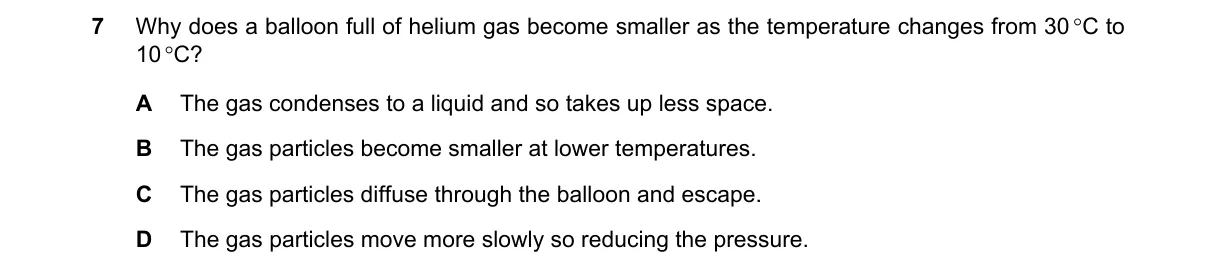
Explanation
Charles's Law: Volume decreases with temperature at constant pressure
Steps:
- Convert temperatures to Kelvin: 30°C is 303 K, 7°C is 280 K, showing a decrease.
- Helium is an ideal gas; lower temperature reduces average kinetic energy of particles.
- Slower-moving particles collide less forcefully with balloon walls, lowering internal pressure.
- Balloon contracts to reduce volume until internal pressure matches external pressure.
Why D is correct:
- Kinetic molecular theory states gas pressure arises from particle collisions; slower particles at lower temperature reduce collision frequency and force, decreasing pressure and thus volume (PV = nRT, constant P implies V ∝ T).
Why the others are wrong:
- A: Helium's boiling point is -269°C, so it remains gaseous at 7°C and does not condense.
- B: Diffusion is minimal for helium in latex balloons over short times; volume change is due to temperature, not escape.
- C: Diffusion rate decreases with temperature, but this does not explain volume reduction; pressure change is key.
Final answer: D
Topic: Solids, liquids and gases
Practice more O Levels Chemistry (5070) questions on mMCQ.me