O Levels Chemistry (5070)•5070/12/O/N/19
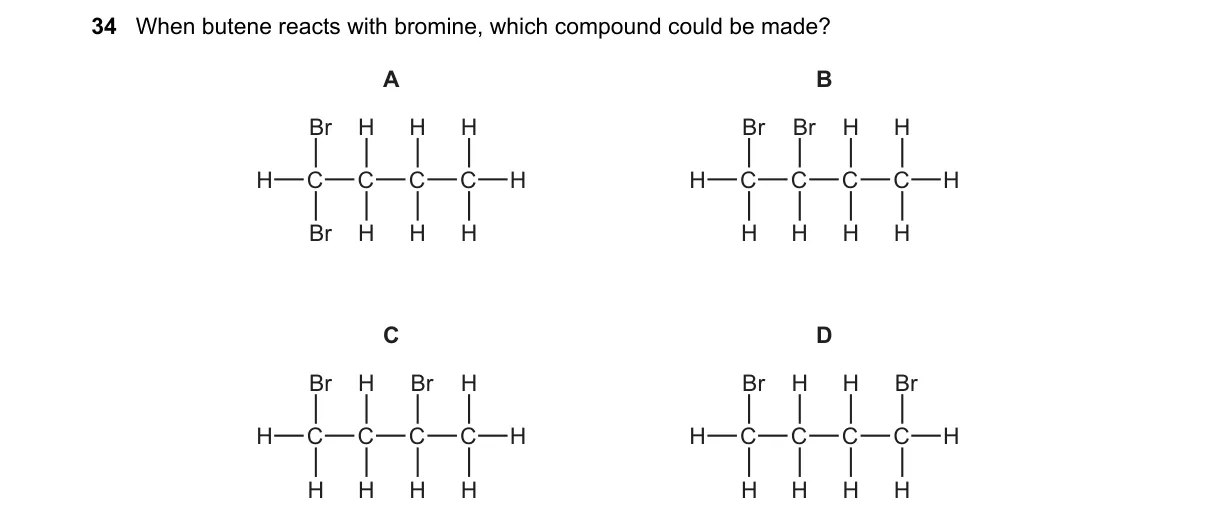
Explanation
Electrophilic addition of bromine to butene forms a vicinal dibromide
Steps:
- Butene (C4H8) is an alkene with a C=C double bond that undergoes electrophilic addition with Br2.
- Br2 approaches the double bond, forming a bromonium ion intermediate.
- A bromide ion then attacks the intermediate, adding Br atoms across the double bond.
- The product is 1,2-dibromobutane (for 1-butene) or 2,3-dibromobutane (for 2-butene), a vicinal dihalide.
Why B is correct:
- B represents the vicinal dibromide (e.g., CH3CH2CHBrCH2Br), matching the anti-addition product from the reaction mechanism.
Why the others are wrong:
- A is a substitution product, but alkenes undergo addition, not substitution with Br2.
- C is a geminal dibromide, which requires different reagents like NBS, not Br2 addition.
- D is an unsaturated compound, but the reaction saturates the double bond.
Final answer: B
Topic: Alkenes
Practice more O Levels Chemistry (5070) questions on mMCQ.me