O Levels Chemistry (5070)•5070/12/O/N/19
Explanation
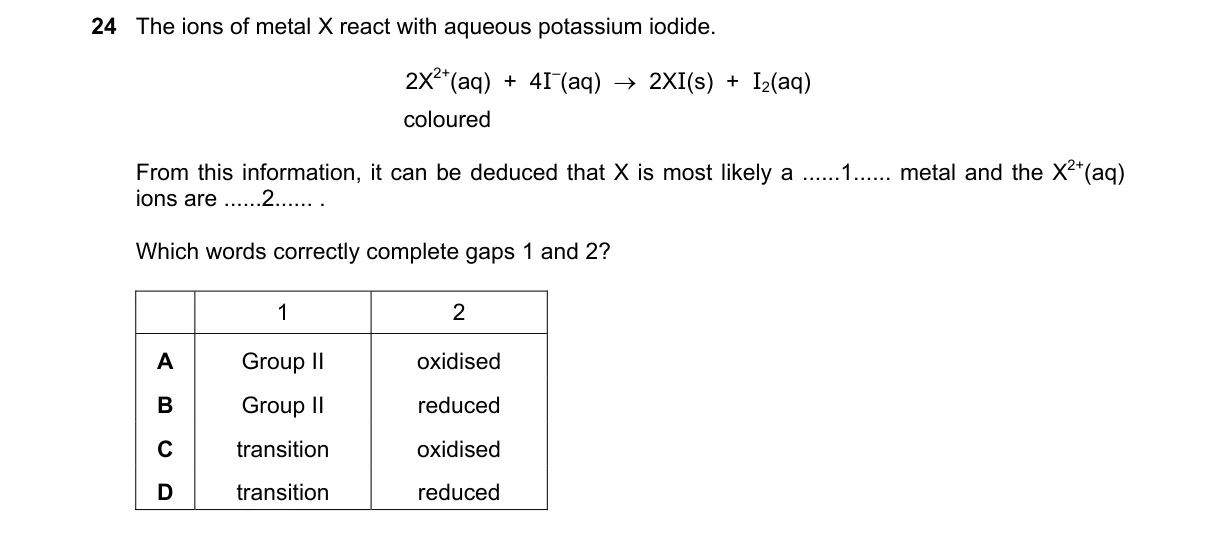
Redox reaction where iodide reduces X²⁺ to metal X Steps:
- Identify the redox process: X²⁺ gains 2 electrons to form X(s), so X²⁺ is reduced; I⁻ loses electrons to form I₂, so I⁻ is oxidized.
- Determine spontaneity condition: For the reaction to occur, standard reduction potential E°(X²⁺/X) > E°(I₂/I⁻) = +0.54 V.
- Classify metals: Group II metals have E° << +0.54 V (e.g., Mg²⁺/Mg = -2.37 V), so their ions cannot be reduced by I⁻.
- Conclude metal type: Only some transition metals have E° > +0.54 V (e.g., Pd²⁺/Pd = +0.99 V), allowing reduction to metal.
Why D is correct:
- Transition metals like Pd have E°(X²⁺/X) > +0.54 V, enabling I⁻ to reduce X²⁺ per the Nernst equation for positive cell potential.
Why the others are wrong:
- A: Group II metals have negative E° values, preventing reduction by I⁻.
- B: Group II ions cannot be reduced by I⁻ due to unfavorable potentials.
- C: While X is a transition metal, the key process is reduction of X²⁺, not oxidation.
Final answer: D
Topic: Transition elements
Practice more O Levels Chemistry (5070) questions on mMCQ.me