O Levels Chemistry (5070)•5070/11/O/N/19
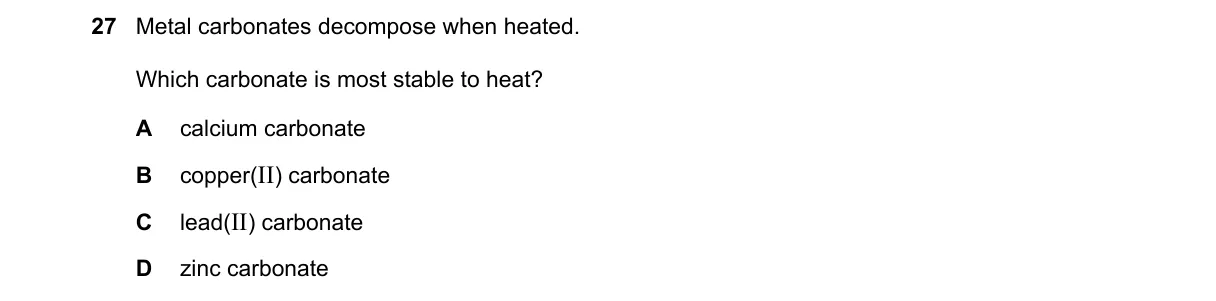
Explanation
Thermal stability increases with decreasing charge density of the cation Steps:
- Identify cations: Ca²⁺ (Group 2), Cu²⁺ and Zn²⁺ (small d-block), Pb²⁺ (large but post-transition).
- Thermal stability of MCO₃ depends on cation's polarizing power; higher charge density (charge/size) polarizes CO₃²⁻ more, easing decomposition to MO + CO₂.
- Compare sizes: Cu²⁺ (73 pm) and Zn²⁺ (74 pm) smallest, highest density; Ca²⁺ (100 pm) moderate; Pb²⁺ (119 pm) largest but weaker M-O bonds.
- Thus, CaCO₃ requires highest temperature (~840°C) for decomposition.
Why A is correct:
- Ca²⁺ has lower charge density than d-block ions, polarizing CO₃²⁻ less per Fajans' rules, stabilizing the carbonate.
Why the others are wrong:
- B: Cu²⁺ small size, high charge density causes easy polarization and decomposition (~200°C).
- C: Pb²⁺ large but inert pair effect weakens Pb-O bonds, allowing decomposition (~350°C).
- D: Zn²⁺ small d-block ion with high charge density leads to low stability (~300°C).
Final answer: A
Topic: Reactivity series
Practice more O Levels Chemistry (5070) questions on mMCQ.me