O Levels Chemistry (5070)•5070/12/O/N/18
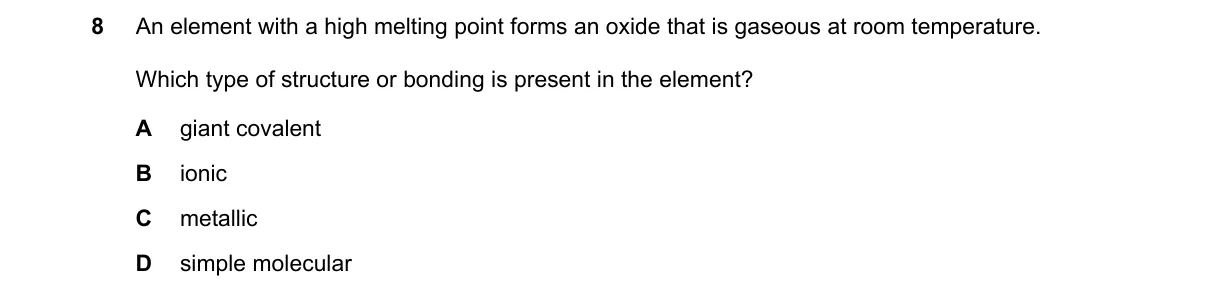
Explanation
Giant covalent elements form gaseous oxides despite high melting points
Steps:
- High melting point indicates strong, extended bonding in the element, ruling out weak intermolecular forces.
- Gaseous oxide at room temperature suggests the oxide is simple molecular, typical of non-metal oxides like CO2.
- Non-metals with giant covalent structures (e.g., carbon, silicon) have high melting points from vast covalent networks.
- Thus, the element must have giant covalent bonding to match both properties.
Why A is correct:
- Giant covalent structures feature continuous strong covalent bonds, yielding high melting points; non-metals form simple molecular oxides that are gases due to weak forces between molecules.
Why the others are wrong:
- B. Ionic: Oxides are solid ionic lattices with high melting points, not gases.
- C. Metallic: Metals form solid ionic oxides; melting points vary but don't typically yield gaseous oxides.
- D. Simple molecular: Low melting points from weak van der Waals forces contradict the high melting point.
Final answer: A
Topic: Giant covalent structures
Practice more O Levels Chemistry (5070) questions on mMCQ.me