O Levels Chemistry (5070)•5070/11/O/N/18
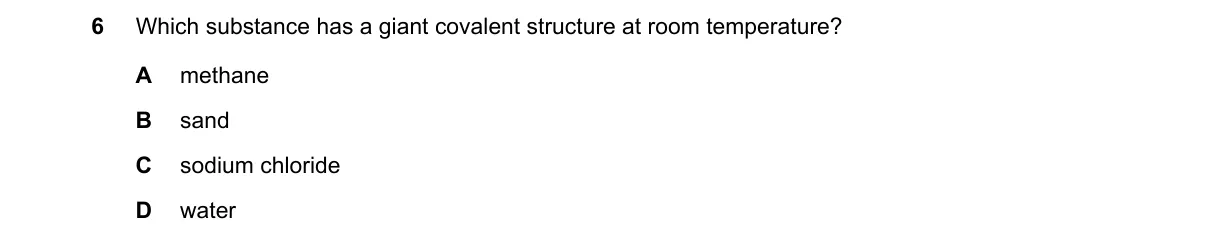
Explanation
Giant covalent structures feature extended 3D networks of covalent bonds
Steps:
- Recall giant covalent structures consist of atoms linked by covalent bonds in a continuous lattice, like diamond or silicon dioxide.
- Analyze methane: CH4 forms discrete molecules with weak van der Waals forces, not a lattice.
- Analyze sand: SiO2 has silicon and oxygen atoms in a tetrahedral covalent network extending infinitely.
- Analyze sodium chloride and water: NaCl is ionic with oppositely charged ions; H2O is molecular with hydrogen bonds between separate units.
Why B is correct:
- Sand is silicon dioxide (SiO2), where each silicon bonds covalently to four oxygens in a giant tetrahedral lattice, per the structure of quartz.
Why the others are wrong:
- A: Methane is a simple molecular compound with isolated CH4 molecules held by weak forces.
- C: Sodium chloride forms a giant ionic lattice of Na+ and Cl- ions attracted electrostatically.
- D: Water consists of discrete H2O molecules linked by hydrogen bonds, not covalent networks.
Final answer: B
Topic: Giant covalent structures
Practice more O Levels Chemistry (5070) questions on mMCQ.me