O Levels Chemistry (5070)•5070/11/O/N/18
Explanation
Transition metals exhibit characteristic d-block properties
Steps:
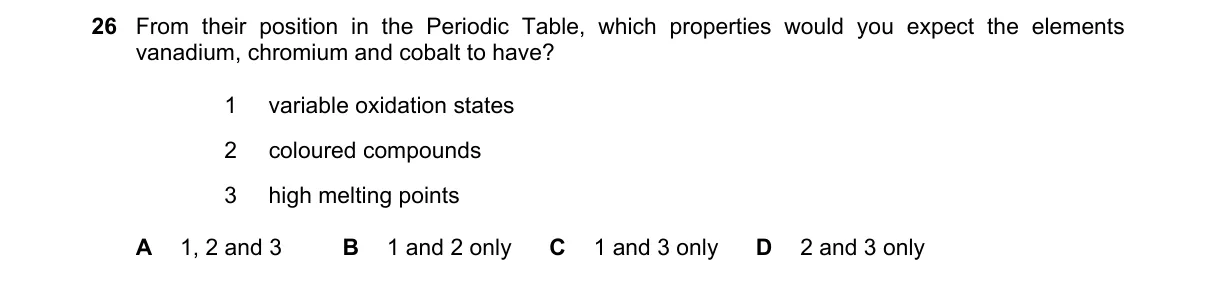
- Locate vanadium (group 5), chromium (group 6), and cobalt (group 9) in the d-block of the Periodic Table, classifying them as transition metals.
- Transition metals have partially filled d orbitals, enabling variable oxidation states through d-electron involvement in bonding.
- Incomplete d subshells allow d-d electron transitions, absorbing visible light and forming colored compounds.
- Strong metallic bonding from delocalized d electrons results in high melting points for these elements.
Why A is correct:
- Transition metals, by definition, display all three properties due to their d-block electron configuration (ns¹⁻² (n-1)d¹⁻¹⁰).
Why the others are wrong:
- B omits high melting points, a key feature of d-block metallic bonding.
- C excludes colored compounds, arising from d-d transitions.
- D ignores variable oxidation states, central to transition metal reactivity.
Final answer: A
Topic: Transition elements
Practice more O Levels Chemistry (5070) questions on mMCQ.me