O Levels Chemistry (5070)•5070/12/M/J/25
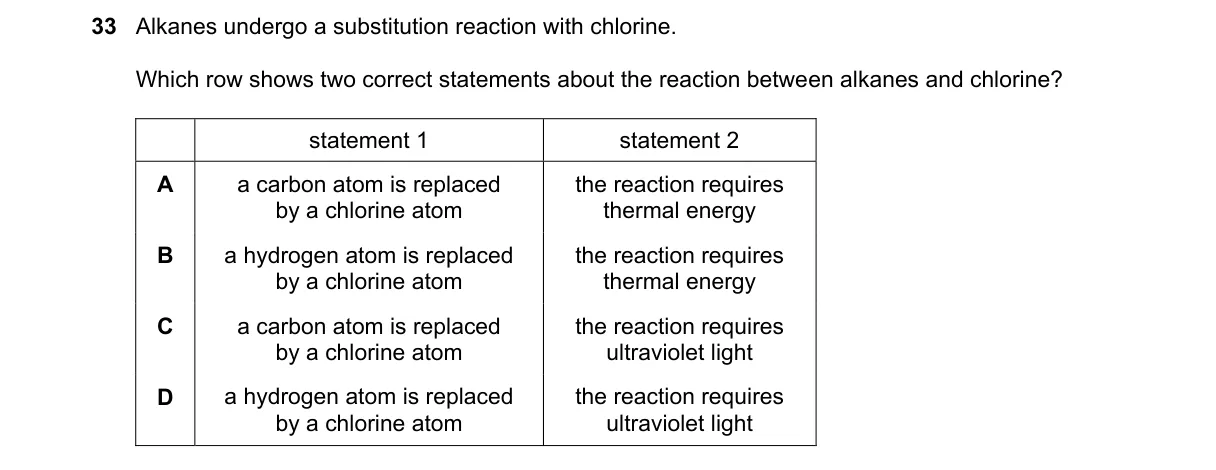
Explanation
Free Radical Chlorination of Alkanes
Steps:
- Alkanes react with Cl₂ via free radical substitution, replacing one atom with chlorine.
- Initiation requires homolytic cleavage of Cl-Cl bond, typically by ultraviolet light to form Cl• radicals.
- Propagation involves H• abstraction from alkane by Cl•, followed by HCl formation and Cl• regeneration.
- Termination forms stable products like alkyl chloride, confirming hydrogen replacement.
Why C is correct:
- Free radical substitution replaces a hydrogen atom with chlorine; UV light initiates by generating chlorine radicals (Cl-Cl bond energy 242 kJ/mol, absorbed by UV).
Why the others are wrong:
- A: Carbon atoms are not replaced; thermal energy alone does not efficiently initiate chlorination.
- B: Hydrogen atom is replaced, but reaction requires UV light, not thermal energy.
- D: Carbon atoms are not replaced, despite UV light being required.
Final answer: C
Topic: Alkanes
Practice more O Levels Chemistry (5070) questions on mMCQ.me