O Levels Chemistry (5070)•5070/11/M/J/24
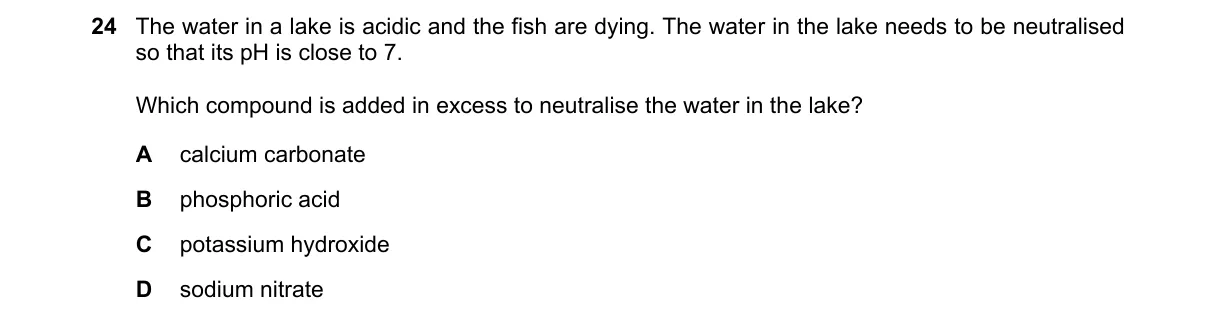
Explanation
Neutralizing acidic water with a base
Steps:
- Identify the problem: Lake water is acidic (pH < 7), harming fish; neutralization targets pH ≈ 7.
- Determine requirement: Add a compound that reacts with H⁺ ions to raise pH without overshooting when added in excess.
- Evaluate options: Select a mild base suitable for aquatic environments, like those used in liming lakes.
- Confirm choice: Calcium carbonate provides buffering action for stable pH control.
Why A is correct:
- Calcium carbonate (CaCO₃) is a weak base that reacts with acids via CaCO₃ + 2H⁺ → Ca²⁺ + H₂O + CO₂, neutralizing H⁺ ions and forming harmless products, commonly used in lake liming to buffer pH near 7 even in excess.
Why the others are wrong:
- B: Phosphoric acid (H₃PO₄) is an acid that adds H⁺, lowering pH further.
- C: Potassium hydroxide (KOH) is a strong base; excess addition would raise pH >7, making water alkaline.
- D: Sodium nitrate (NaNO₃) is a neutral salt with no acid-base reaction, so it has no neutralizing effect.
Final answer: A
Topic: The characteristic properties of acids and bases
Practice more O Levels Chemistry (5070) questions on mMCQ.me