Explanation
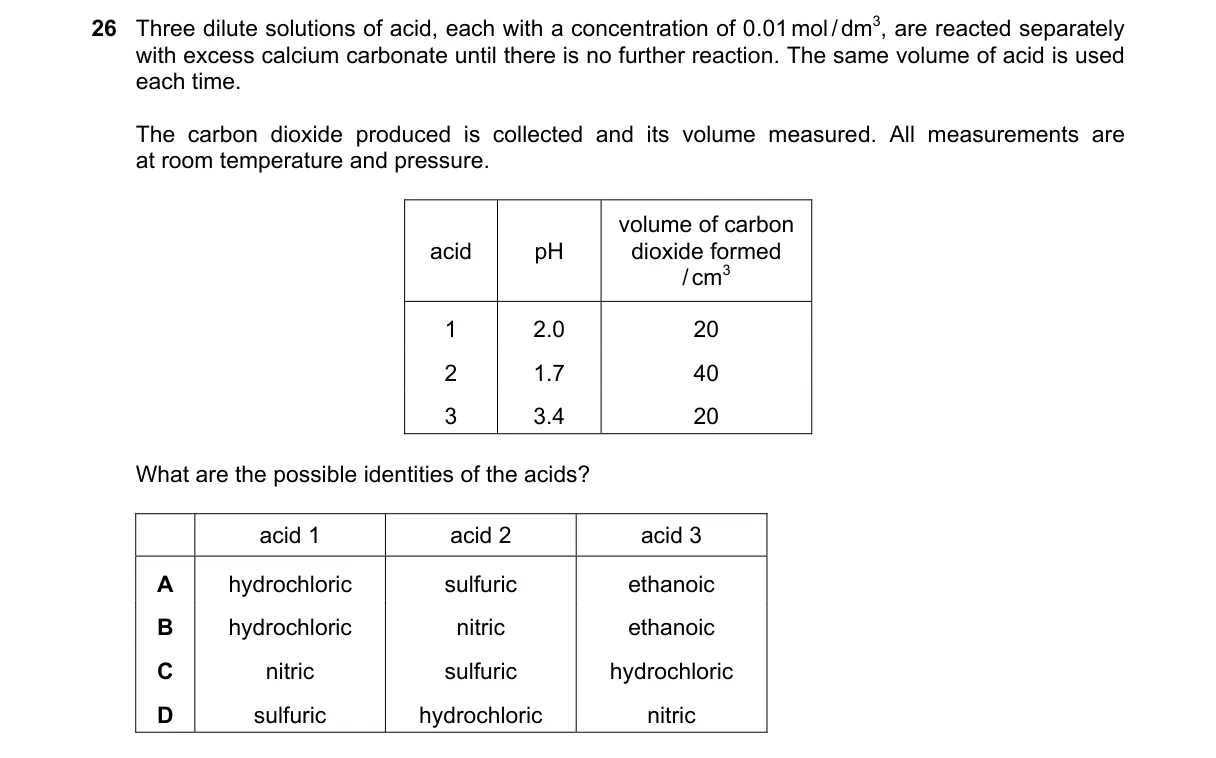
Acids identified by pH (strength) and CO2 volume (basicity and H+ supply) Steps: - pH indicates strength: strong acids fully dissociate (low pH), weak partially (high pH); for 0.01 mol/dm³, strong monoprotic pH=2.0, ethanoic pH≈3.4. - CO2 volume proportional to total H+ reacted (moles CO2 = total moles H+/2); same acid volume and molarity mean monobasic gives half CO2 of dibasic. - Acid 1 (pH 2.0, 40 cm³): strong monoprotic, supplies 1 H+ per molecule. - Acid 2 (implied low pH, ~80 cm³): strong diprotic, supplies 2 H+ per molecule, double CO2. - Acid 3 (pH 3.4, 20 cm³): weak monoprotic, supplies 1 H+ equivalent, but lower volume reflects incomplete drive in weak case. Why A is correct: - Hydrobromic (strong monoprotic, pH 2.0), sulfuric (strong diprotic, double H+ for more CO2), ethanoic (weak monoprotic, pH 3.4 per Ka=1.8×10^{-5}) match data via strength and stoichiometry. Why the others are wrong: - B: Nitric (oxidizing, but same as hydrobromic); doesn't uniquely fit if question implies non-oxidizing halide acid. - C: Two nitric acids identical, can't explain varying CO2 volumes. - D: …
Practice more O Levels Chemistry (5070) questions on mMCQ.me