O Levels Chemistry (5070)•5070/11/M/J/22
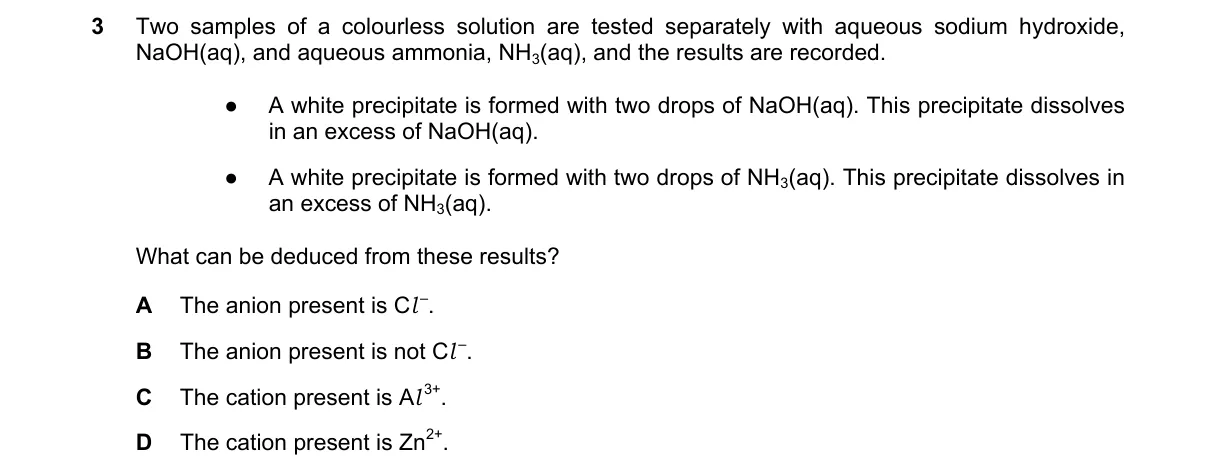
Explanation
Tests confirm Zn²⁺ cation via amphoteric behavior
Steps:
- White ppt with NaOH(aq) dissolving in excess indicates amphoteric hydroxide formation, like Zn(OH)₂ → [Zn(OH)₄]²⁻.
- White ppt with NH₃(aq) dissolving in excess indicates soluble ammine complex, like Zn(OH)₂ → [Zn(NH₃)₄]²⁺.
- This dual solubility rules out non-amphoteric cations like Al³⁺, which ppts but doesn't dissolve in NH₃.
- Anions do not form these ppts; observations point to specific cation reactivity.
Why C is correct:
- Zn²⁺ produces white Zn(OH)₂ ppt with both NaOH and NH₃, dissolving in excess via complex ions [Zn(OH)₄]²⁻ and [Zn(NH₃)₄]²⁺ as per qualitative analysis.
Why the others are wrong:
- A: Cl⁻ does not form ppts with NaOH or NH₃; these tests detect cations.
- B: NO₃⁻ is spectator ion, yielding no such ppts.
- D: NH₄⁺ + NaOH releases NH₃ gas, no ppt; no reaction with NH₃.
Final answer: C
Topic: Identification of ions and gases
Practice more O Levels Chemistry (5070) questions on mMCQ.me