O Levels Chemistry (5070)•5070/11/M/J/22
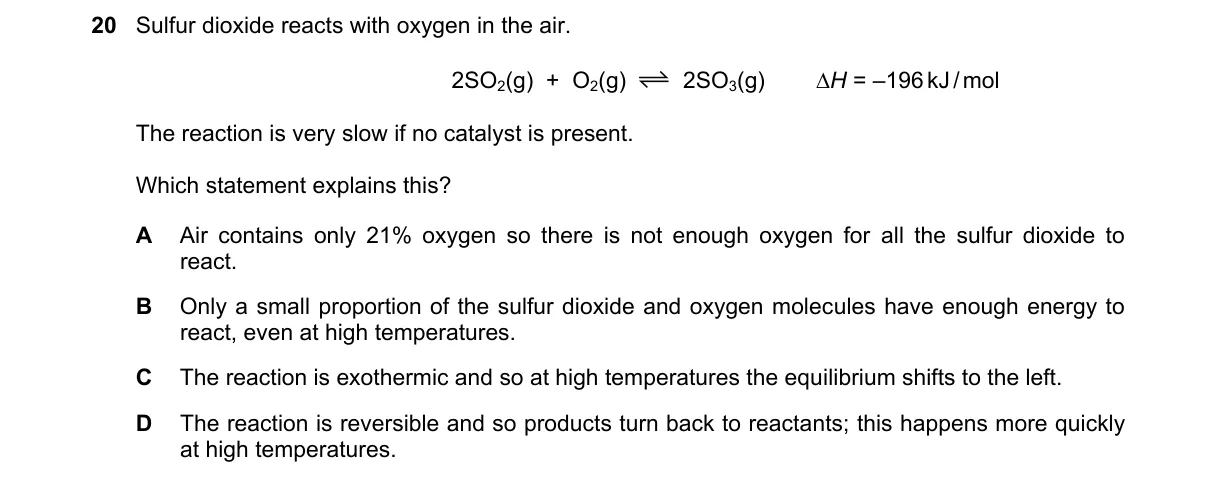
Explanation
Activation Energy Barrier
Steps:
- Reaction rate depends on collisions between SO₂ and O₂ molecules with energy exceeding the activation energy (E_a).
- At ambient temperatures, only a small fraction of molecules possess this minimum E_a, leading to few successful collisions.
- Without a catalyst to lower E_a, the reaction proceeds slowly despite being thermodynamically favorable (exothermic).
- Catalysts increase the proportion of energetic molecules, but here none is present, explaining the slowness.
Why B is correct:
- Collision theory states that reaction rate is proportional to the fraction of molecules with energy ≥ E_a; B directly describes this low fraction without a catalyst.
Why the others are wrong:
- A: Oxygen concentration (21%) is sufficient; slowness is kinetic, not due to reactant shortage.
- C: Equilibrium position (Le Chatelier's principle) affects yield, not initial rate or catalyst absence.
- D: Reversibility impacts equilibrium, but slowness stems from high forward E_a, not temperature-driven reversal.
Final answer: B
Topic: Rate of reaction
Practice more O Levels Chemistry (5070) questions on mMCQ.me