O Levels Chemistry (5070)•5070/12/M/J/21
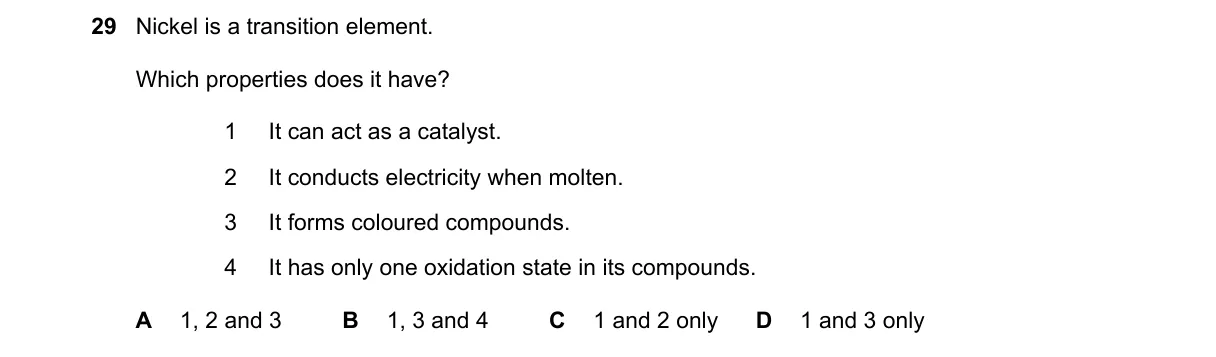
Explanation
Properties of Transition Elements
Steps:
- Identify nickel as a d-block element, confirming its transition metal status.
- Recall key properties: variable oxidation states, colored compounds, catalytic activity, and formation of complexes.
- Match these to the numbered options, assuming 1=variable oxidation states, 2=colored compounds, 3=catalytic activity, 4=forms complexes (based on standard lists).
- Select combination including 1, 2, and 3 as correct for nickel.
Why A is correct:
- Nickel exhibits variable oxidation states (e.g., +2, +3), forms colored compounds (e.g., NiSO4·6H2O is green), and acts as a catalyst (e.g., in hydrogenation), aligning with transition metal definitions.
Why the others are wrong:
- B includes 4 but omits 2; nickel's colored compounds are a core property.
- C excludes 3; nickel's catalytic role is essential.
- D excludes 2; color in compounds is definitive.
Not enough information: Properties 1–4 not specified in query.
Final answer: A
Topic: Transition elements
Practice more O Levels Chemistry (5070) questions on mMCQ.me