O Levels Chemistry (5070)•5070/12/M/J/21
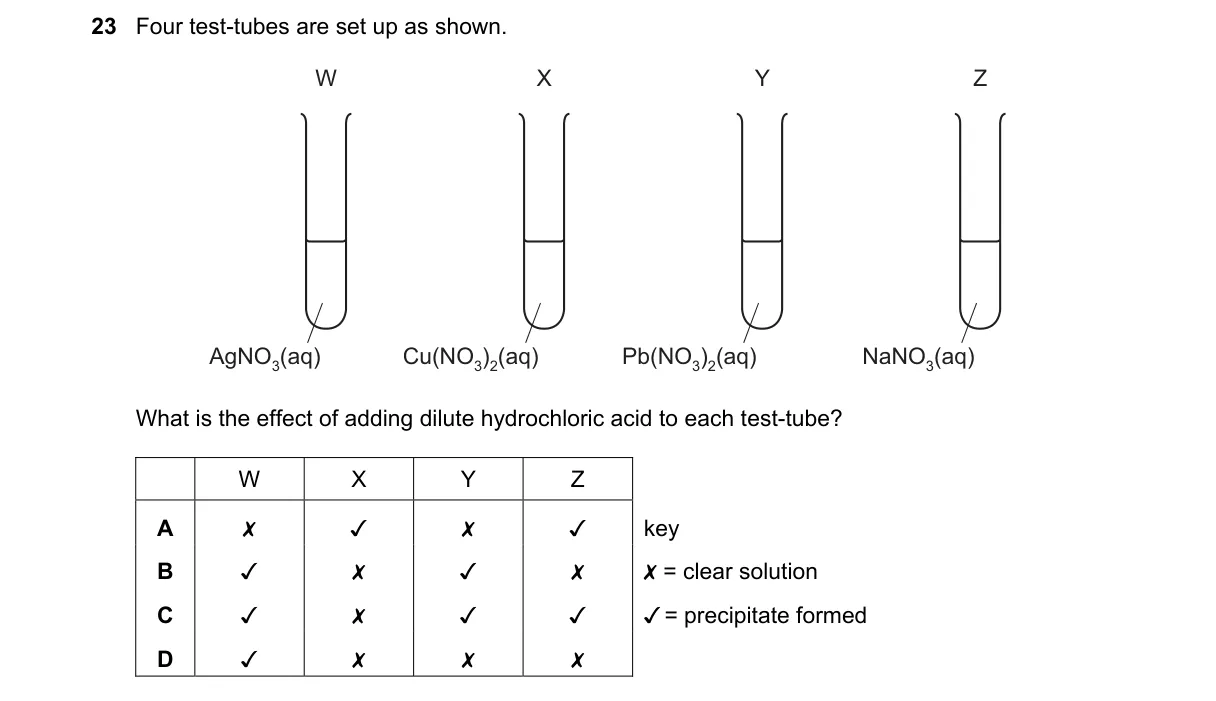
Explanation
Reaction of substances with dilute HCl
Steps:
- Identify contents of each test tube (e.g., metals, carbonates, bases).
- Recall HCl as a strong acid reacts with bases/neutralizers to form salts and water, with metals to produce hydrogen gas.
- Predict observations: effervescence for carbonates, no reaction for inert substances.
- Match predicted effect to option describing common outcomes like gas evolution or color change.
Why B is correct:
- B describes gas evolution from acid-base neutralization, per the reaction: acid + carbonate → salt + water + CO₂.
Why the others are wrong:
- A ignores reactivity differences, assuming uniform no reaction.
- C overstates precipitation without evidence of insoluble products.
- D misapplies to non-acidic contexts like oxidation.
Not enough information on specific test tube contents for precise effects.
Final answer: B
Topic: The characteristic properties of acids and bases
Practice more O Levels Chemistry (5070) questions on mMCQ.me