O Levels Chemistry (5070)•5070/11/M/J/21
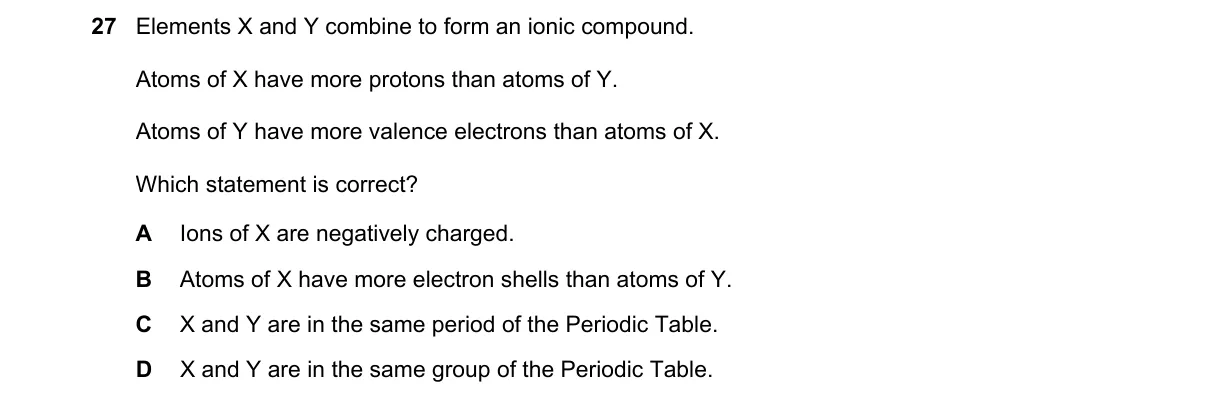
Explanation
Valence electrons drive ionic compound formation Steps:
- Ionic compounds form via electron transfer from metal to nonmetal.
- Metals (low electronegativity) have 1–3 valence electrons and donate them easily.
- Nonmetals (high electronegativity) have 5–7 valence electrons and accept electrons to fill octets.
- Thus, nonmetal atoms always have more valence electrons than metal atoms.
Why B is correct:
- Nonmetals require fewer electrons to complete their octet, so their atoms start with more valence electrons than metal atoms, as per octet rule.
Why the others are wrong:
- A: Ions of X could be positive if X is the metal (cation).
- C: Ionic compounds often involve elements from different periods, like Na (period 3) and F (period 2).
- D: Metals and nonmetals belong to different groups (e.g., group 1 vs. group 17).
Final answer: B
Topic: Ion and ionic bonds
Practice more O Levels Chemistry (5070) questions on mMCQ.me