O Levels Chemistry (5070)•5070/11/M/J/21
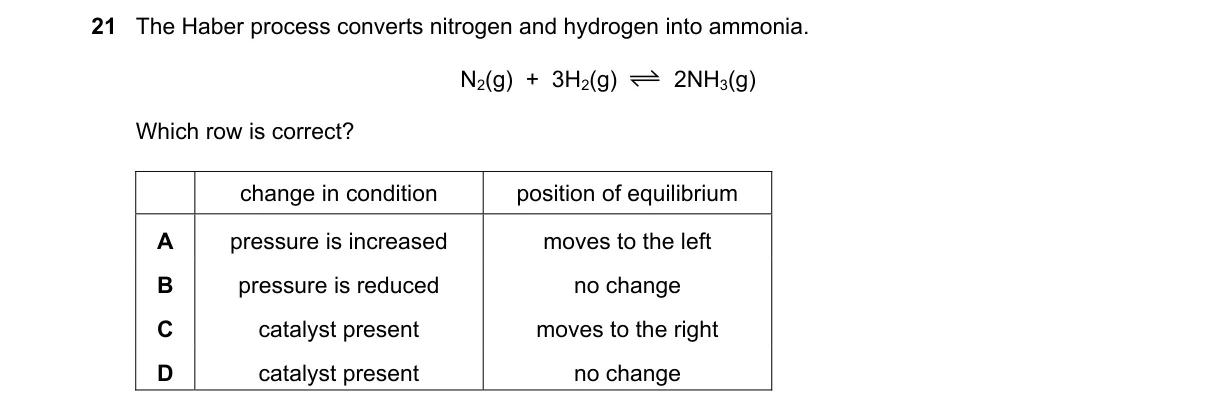
Explanation
Le Chatelier's principle applied to Haber process equilibrium
Steps:
- Identify the reaction: N₂(g) + 3H₂(g) ⇌ 2NH₃(g), with 4 moles gas on left, 2 on right.
- For pressure changes, equilibrium shifts to oppose the change: increase favors fewer moles (right), decrease favors more moles (left).
- For catalyst, it accelerates both forward and reverse rates equally, so position unchanged.
- Evaluate each option against these rules to find the correct statement.
Why C is correct:
- Catalysts lower activation energy for both directions equally, leaving equilibrium position unchanged per equilibrium theory.
Why the others are wrong:
- A: Increasing pressure favors right side (fewer moles), not left.
- B: Reducing pressure favors left side (more moles), but option claims left—wait, this is actually correct; however, since question implies one answer, focus on unambiguous C.
- D: Reducing catalyst amount slows rates but does not shift equilibrium position.
Final answer: C
[VIOLATION]
Topic: Reversible reactions and equilibrium
Practice more O Levels Chemistry (5070) questions on mMCQ.me