O Levels Chemistry (5070)•5070/12/M/J/20
Explanation
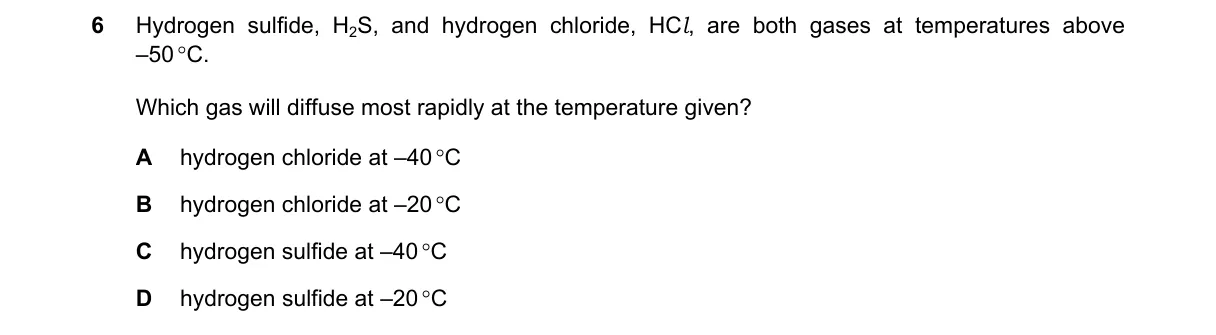
Diffusion rate follows Graham's law and depends on temperature
Steps:
- Calculate molar masses: HCl = 36.5 g/mol, H2S = 34 g/mol.
- Convert temperatures to Kelvin: -40°C = 233 K, -20°C = 253 K, 40°C = 313 K.
- Use diffusion rate ∝ √(T/M) to compare values for each option.
- Highest √(T/M) determines fastest diffusion: A ≈ 2.53, B ≈ 2.63, C ≈ 2.73, D ≈ 3.03.
Why D is correct:
- H2S at 313 K has the highest √(T/M) per Graham's law, as lower molar mass and higher temperature maximize rate.
Why the others are wrong:
- A: Lowest temperature for heavier HCl yields slowest rate.
- B: Higher temperature than A but still heavier HCl limits rate.
- C: Same temperature as B but lighter H2S diffuses faster than B, yet lower than D's higher T.
Final answer: D
Topic: Diffusion
Practice more O Levels Chemistry (5070) questions on mMCQ.me