O Levels Chemistry (5070)•5070/12/M/J/20
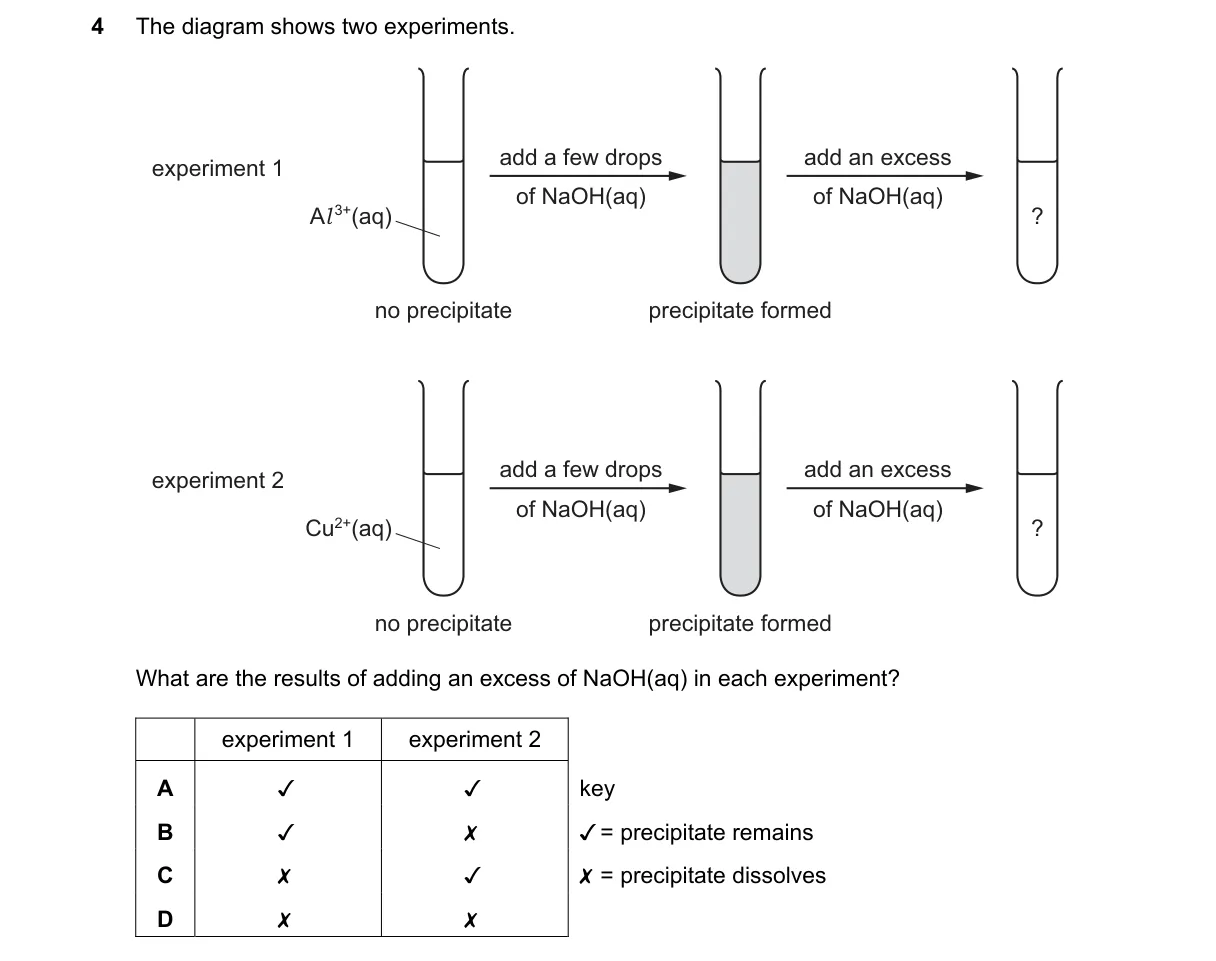
Explanation
Amphoteric hydroxides dissolve in excess NaOH
Steps:
- Precipitates form in both experiments upon initial NaOH addition, indicating metal hydroxides.
- Excess NaOH tests for amphoteric behavior, where certain hydroxides (e.g., Al(OH)3, Zn(OH)2) react to form soluble complexes.
- In experiment 1, the precipitate dissolves due to amphoteric nature, confirmed by observation.
- In experiment 2, the same dissolution occurs, matching the x symbol for dissolution in both.
Why C is correct:
- Amphoteric hydroxides dissolve in excess base per the reaction Al(OH)3 + OH- → [Al(OH)4]-, forming soluble tetrahydroxoaluminate.
Why the others are wrong:
- A incorrectly states precipitates remain in both, ignoring amphoteric dissolution.
- B mislabels outcomes as remaining without dissolution in either.
- D duplicates C's description but uses incorrect formatting or symbols for the experiments.
Final answer: C
Topic: Identification of ions and gases
Practice more O Levels Chemistry (5070) questions on mMCQ.me