O Levels Chemistry (5070)•5070/12/M/J/20
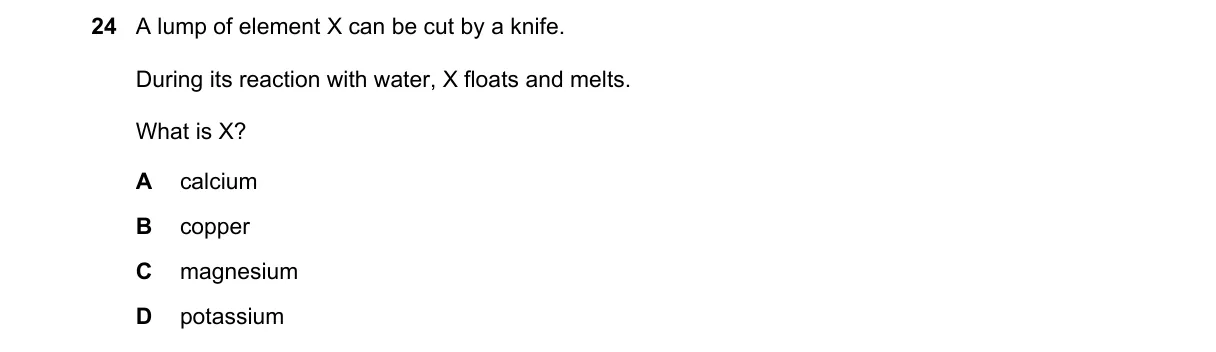
Explanation
Alkali metal reactivity and physical properties
Steps:
- Element X is soft enough to cut with a knife, indicating low hardness typical of alkali metals.
- X floats on water, showing low density less than 1 g/cm³.
- X melts during the reaction, due to intense exothermic heat from water reactivity.
- These traits match potassium's vigorous reaction: 2K + 2H₂O → 2KOH + H₂, producing hydrogen gas and sufficient heat to melt the metal.
Why D is correct:
- Potassium (density 0.86 g/cm³) is soft, floats, and its reaction with water (2K + 2H₂O → 2KOH + H₂) generates enough heat (ΔH exothermic) to raise its low melting point (63°C) above ambient temperature.
Why the others are wrong:
- A. Calcium: Too dense (1.55 g/cm³) to float and harder, not cut by knife.
- B. Copper: Inert to water, no reaction or melting.
- C. Magnesium: Reacts slowly with water, sinks (density 1.74 g/cm³), and doesn't melt.
Final answer: D
Topic: Group I properties
Practice more O Levels Chemistry (5070) questions on mMCQ.me