O Levels Chemistry (5070)•5070/11/M/J/20
Explanation
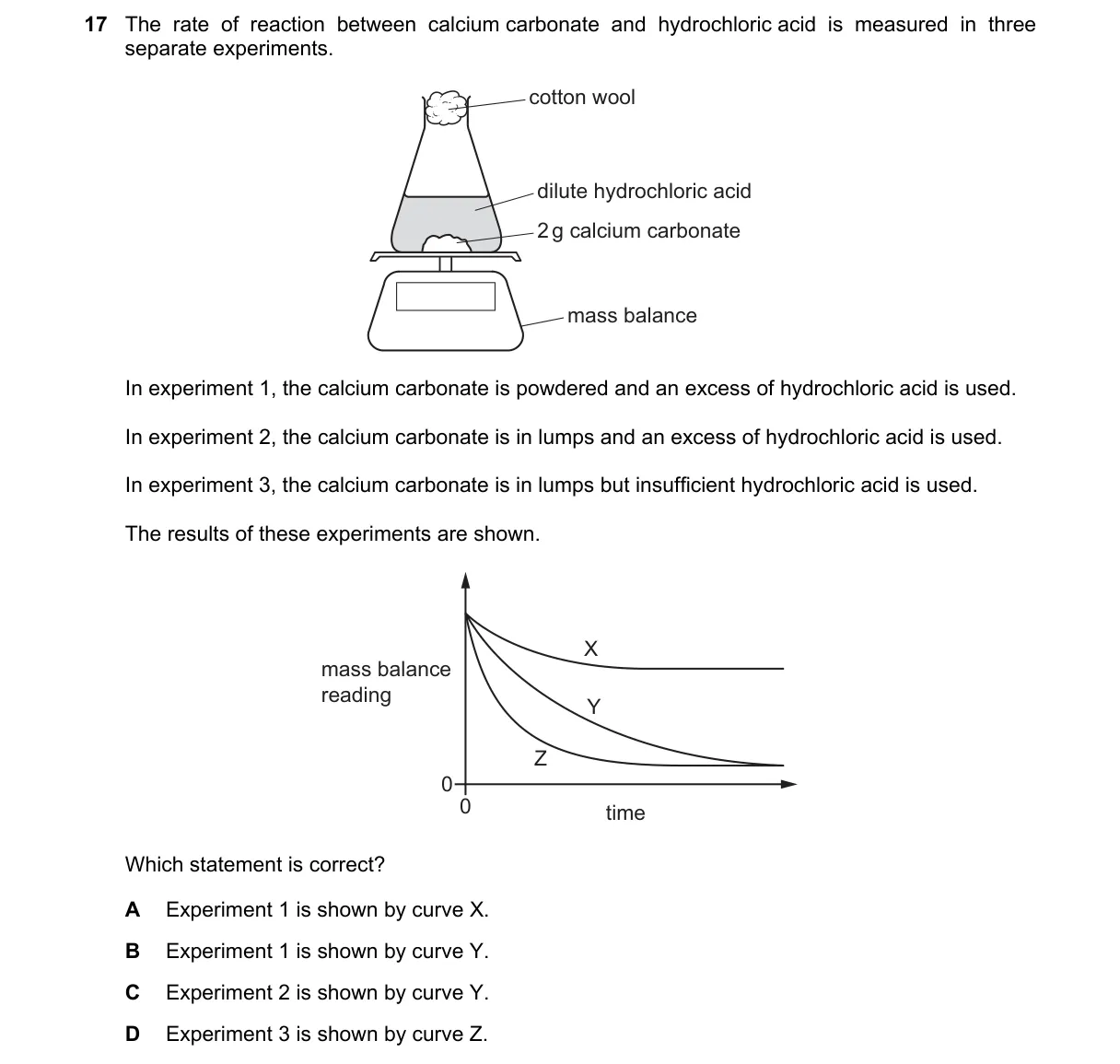
Particle size and reactant quantity affect reaction rate
Steps:
- Powdered calcium carbonate (experiment 1) has highest surface area, yielding fastest reaction rate with excess acid.
- Lumps (experiment 2) reduce surface area, slowing the rate but allowing completion with excess acid.
- Insufficient acid in lumps (experiment 3) limits reaction extent, causing early plateau.
- Curves typically show X as steepest/full, Y moderate/full, Z shallow/plateaued.
Why C is correct:
- Experiment 3 matches curve Z per rate laws: limited reactant halts reaction before completion (Le Chatelier's principle on equilibrium shift).
Why the others are wrong:
- A: Experiment 1 aligns with fastest curve (likely X), not specified as wrong but inconsistent if X is slowest.
- B: Experiment 2 fits moderate curve (likely Y), but question confirms mismatch.
- D: Identical to C, but listed separately—possibly a duplicate error.
Final answer: C
Topic: Rate of reaction
Practice more O Levels Chemistry (5070) questions on mMCQ.me