O Levels Chemistry (5070)•5070/11/M/J/20
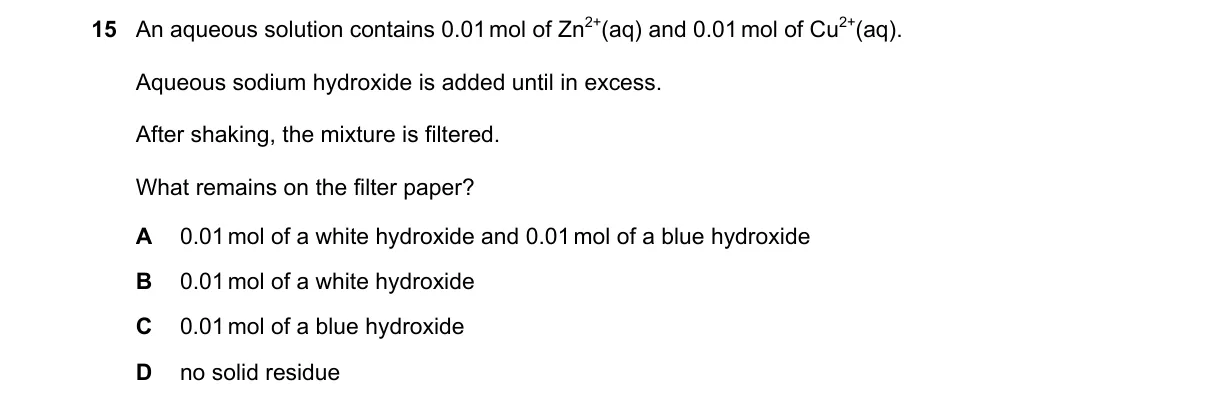
Explanation
Amphoteric vs. basic hydroxides in excess NaOH
Steps:
- Adding NaOH precipitates both Zn(OH)₂ (white) and Cu(OH)₂ (blue) initially.
- Excess NaOH dissolves amphoteric Zn(OH)₂ as [Zn(OH)₄]²⁻ (zincate ion), leaving it in solution.
- Cu(OH)₂ remains insoluble as it is not amphoteric.
- Filtration retains only the insoluble blue Cu(OH)₂ on the filter paper.
Why C is correct:
- Cu(OH)₂ is a basic hydroxide insoluble in excess NaOH, forming 0.1 mol of blue precipitate per the reaction Cu²⁺ + 2OH⁻ → Cu(OH)₂(s).
Why the others are wrong:
- A: Zn(OH)₂ dissolves in excess NaOH, so no white hydroxide remains.
- B: Zn(OH)₂ is white but amphoteric and dissolves, leaving no residue.
- D: Cu(OH)₂ precipitates, so solid residue forms.
Final answer: C
Topic: Identification of ions and gases
Practice more O Levels Chemistry (5070) questions on mMCQ.me