O Levels Chemistry (5070)•5070/11/M/J/20
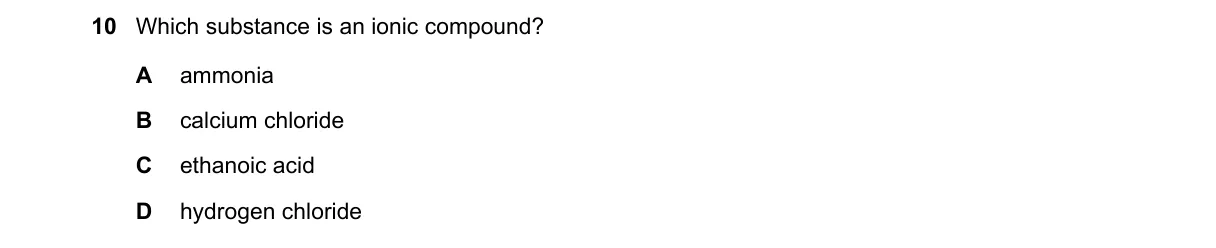
Explanation
Ionic compounds form between metals and non-metals
Steps:
- Ionic compounds typically consist of a metal cation and non-metal anion, forming a lattice structure.
- Identify the chemical formula for each option to check for metal-nonmetal pairs.
- Ammonia (NH₃) involves only non-metals, so covalent.
- Calcium chloride (CaCl₂) pairs metal calcium with non-metal chlorine, so ionic.
- Ethanoic acid (CH₃COOH) and hydrogen chloride (HCl) are molecular with covalent bonds.
Why B is correct:
- Calcium chloride (CaCl₂) is an ionic compound because it forms from the electrostatic attraction between Ca²⁺ cations and Cl⁻ anions, following the definition of ionic bonding between metals and non-metals.
Why the others are wrong:
- A: Ammonia (NH₃) is a covalent molecular compound with shared electrons between nitrogen and hydrogen.
- C: Ethanoic acid (CH₃COOH) is an organic acid with covalent bonds in its carbon chain and functional groups.
- D: Hydrogen chloride (HCl) is a diatomic molecular compound with a covalent bond between hydrogen and chlorine.
Final answer: B
Topic: Ion and ionic bonds
Practice more O Levels Chemistry (5070) questions on mMCQ.me