O Levels Chemistry (5070)•5070/12/M/J/19
Explanation
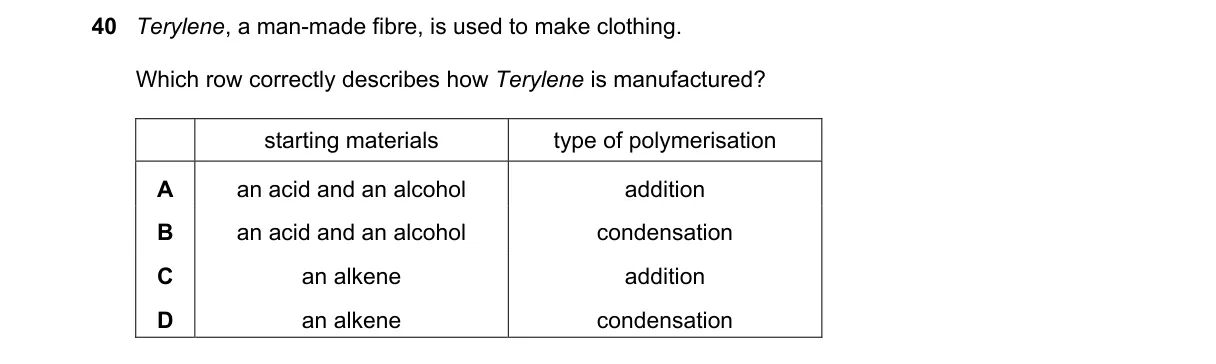
Terylene forms via condensation polymerization of an acid and alcohol
Steps:
- Identify Terylene as a polyester, a type of condensation polymer.
- Recall polyesters form from dicarboxylic acids and diols (alcohols) like terephthalic acid and ethylene glycol.
- Confirm the reaction eliminates water molecules, characteristic of condensation polymerization.
- Rule out addition polymerization, which links monomers without byproducts and suits alkenes.
Why B is correct:
- Terylene is produced by reacting terephthalic acid (dicarboxylic acid) and ethane-1,2-diol (diol alcohol) in a condensation process, forming ester linkages with water elimination, as per the general polyester formation equation: HOOC-R-COOH + HO-R'-OH → [-OOC-R-COO-R'-O-] + H₂O.
Why the others are wrong:
- A: Addition polymerization applies to alkenes, not acid-alcohol reactions that form esters.
- C: Terylene uses acid and alcohol, not alkenes; addition suits polyalkenes like polythene.
- D: Condensation requires functional groups like acids/alcohols; alkenes undergo addition, not condensation.
Final answer: B
Topic: Polymers
Practice more O Levels Chemistry (5070) questions on mMCQ.me