O Levels Chemistry (5070)•5070/11/M/J/19
Explanation
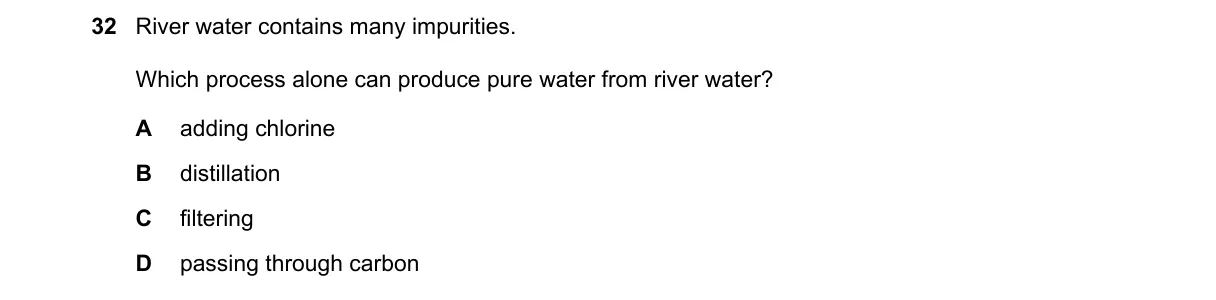
Distillation purifies water by evaporation and condensation
Steps:
- Identify impurities in river water: dissolved salts, microbes, organics, and particles.
- Evaluate each process: check if it removes all impurity types to yield pure H2O.
- Adding chlorine kills microbes but leaves dissolved solids.
- Filtering traps particles but not dissolved ions.
- Distillation evaporates water (boiling point 100°C), leaving non-volatile impurities; condensed vapor is pure.
- Carbon adsorption removes organics but not salts or microbes fully.
Why C is correct:
- Distillation separates based on boiling point differences, yielding 100% pure water per the phase change principle.
Why the others are wrong:
- A: Disinfects but doesn't remove chemical impurities.
- B: Removes suspended solids only, not dissolved ones.
- D: Absorbs some organics but leaves inorganic salts.
Final answer: C
Topic: Water
Practice more O Levels Chemistry (5070) questions on mMCQ.me