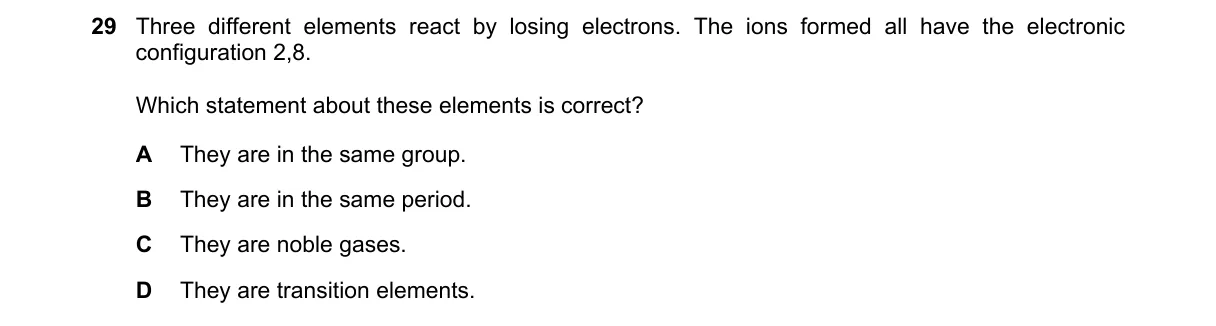
Explanation
Elements Forming Neon-Like Ions Steps: - The configuration 2.8 matches neon (atomic number 10), a stable noble gas with a full octet in the second shell. - These elements lose electrons to achieve this configuration, forming cations with 10 electrons total. - The elements must originate from the third period, as they add electrons to the third shell before losing valence electrons to revert to neon's core. - Examples include sodium (loses 1e⁻ for Na⁺), magnesium (loses 2e⁻ for Mg²⁺), and aluminum (loses 3e⁻ for Al³⁺), all in period 3. Why B is correct: - Elements in the same period share the same outer electron shell and form ions by losing electrons from that shell to match the previous noble gas configuration, per the octet rule. Why the others are wrong: - A: They belong to different groups (1, 2, and 13) based on valence electrons lost. - C: Noble gases have the 2.8 configuration already and do not form ions by losing electrons. - D: Transition elements are in the d-block (periods 4–7) and form ions with incomplete d-subshells, …
Practice more O Levels Chemistry (5070) questions on mMCQ.me