Explanation
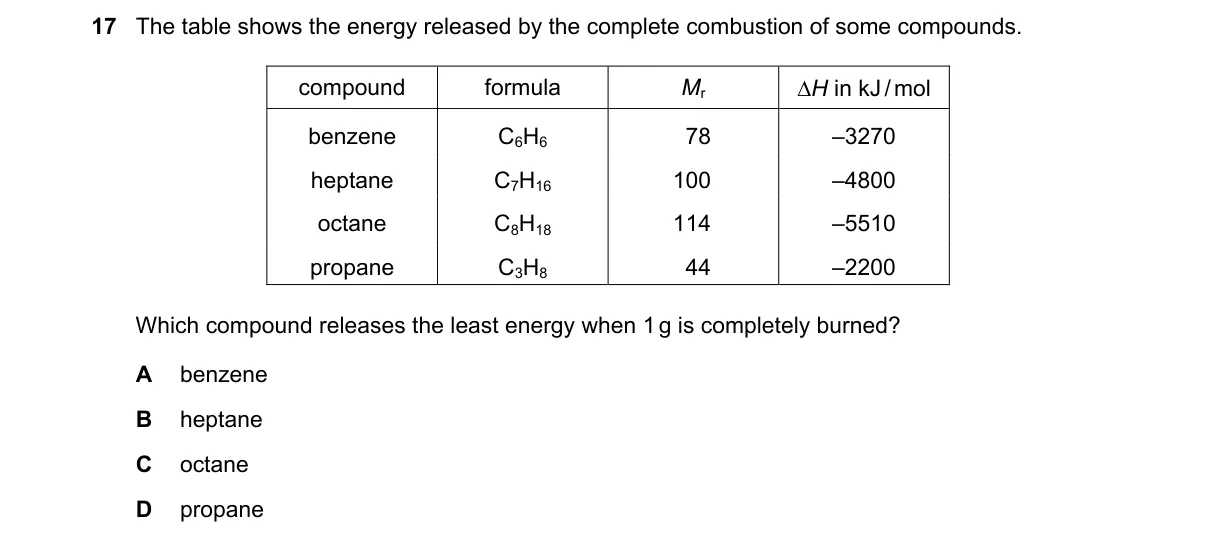
Heat of combustion per gram is molar enthalpy divided by molar mass Steps: - Determine molar masses: benzene (C6H6) = 78 g/mol, heptane (C7H16) = 100 g/mol, octane (C8H18) = 114 g/mol, propane (C3H8) = 44 g/mol. - Recall standard molar heats of combustion: benzene ≈ 3270 kJ/mol, heptane ≈ 4820 kJ/mol, octane ≈ 5450 kJ/mol, propane ≈ 2220 kJ/mol. - Compute per gram: benzene = 3270/78 ≈ 42 kJ/g, heptane = 4820/100 = 48.2 kJ/g, octane = 5450/114 ≈ 48 kJ/g, propane = 2220/44 ≈ 50 kJ/g. - Compare values: benzene yields the lowest energy per gram. Why A is correct: - Benzene's aromatic structure and lower H/C ratio result in less exothermic combustion per unit mass, as confirmed by ΔH_comb / molar mass calculation. Why the others are wrong: - B: Heptane's higher saturation and H content give more energy from H2O formation, yielding ~48 kJ/g. - C: Octane, like heptane, is a saturated alkane with ~48 kJ/g due to similar bond energies per gram. - D: Propane's low molar mass amplifies its high per-mole energy, resulting in …
Practice more O Levels Chemistry (5070) questions on mMCQ.me