O Levels Chemistry (5070)•5070/12/M/J/18
Explanation
Oxidation of Ethylene Glycol to Oxalic Acid
Steps:
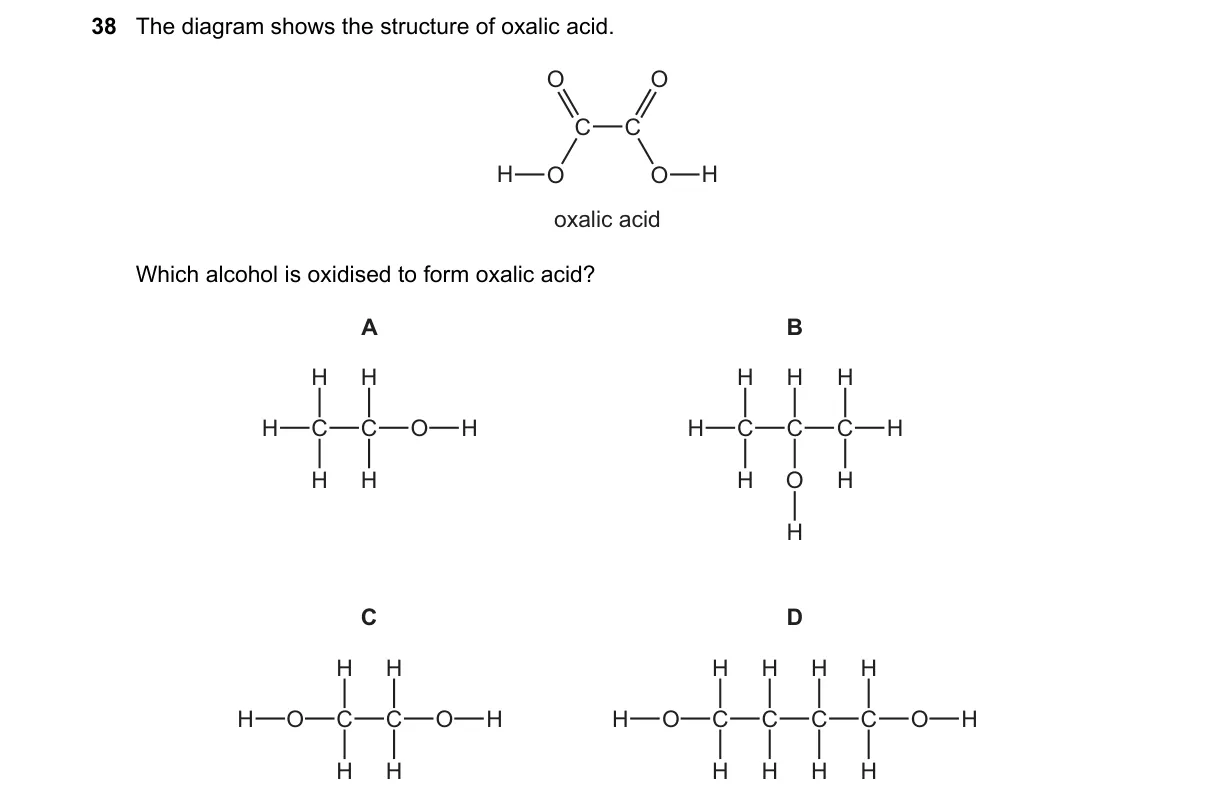
- Identify oxalic acid as HOOC-COOH, a two-carbon dicarboxylic acid formed by complete oxidation of a vicinal diol.
- Recognize that primary alcohols oxidize to carboxylic acids; diols with adjacent OH groups undergo cleavage under strong oxidation.
- Determine the precursor alcohol must be ethylene glycol (HO-CH₂-CH₂-OH), a two-carbon diol.
- Confirm via reaction: KMnO₄ oxidation of ethylene glycol yields oxalic acid by oxidizing both -CH₂OH to -COOH with C-C bond cleavage.
Why C is correct:
- Ethylene glycol (option C) is a 1,2-diol whose both primary alcohol groups oxidize to carboxylic acids, forming HOOC-COOH per standard organic oxidation rules.
Why the others are wrong:
- A (methanol): Oxidizes to formic acid (HCOOH), a one-carbon monoacid.
- B (ethanol): Oxidizes to acetic acid (CH₃COOH), a two-carbon monoacid.
- D (glycerol): Oxidizes to glyceric acid or tartronic acid, not oxalic acid.
Final answer: C
Topic: Alcohols
Practice more O Levels Chemistry (5070) questions on mMCQ.me