O Levels Chemistry (5070)•5070/12/M/J/18
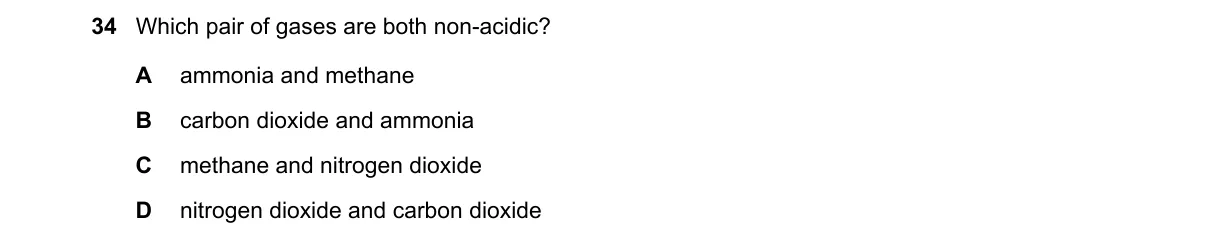
Explanation
Non-acidic gases neither donate protons nor form acids in water.
Steps:
- Define non-acidic gases as those that do not produce H+ ions or acidic solutions when dissolved in water.
- Classify ammonia (NH3): reacts with water to form basic NH4OH, so non-acidic.
- Classify methane (CH4): inert hydrocarbon, no reaction with water, neutral and non-acidic.
- Check other gases: CO2 forms H2CO3 (acidic); NO2 forms HNO3/HNO2 (acidic).
Why A is correct:
- Both ammonia (basic, NH3 + H2O → NH4+ + OH-) and methane (neutral, no ionization) fail to produce acidic solutions.
Why the others are wrong:
- B: Carbon dioxide is acidic (CO2 + H2O → H2CO3).
- C: Nitrogen dioxide is acidic (2NO2 + H2O → HNO2 + HNO3).
- D: Both carbon dioxide and nitrogen dioxide form acids in water.
Final answer: A
Topic: Oxides
Practice more O Levels Chemistry (5070) questions on mMCQ.me