O Levels Chemistry (5070)•5070/12/M/J/18
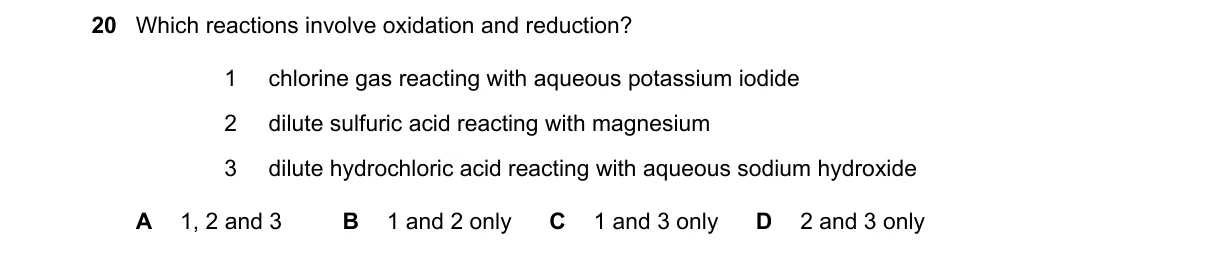
Explanation
Identifying Redox Reactions via Electron Transfer
Steps:
- Redox reactions involve electron transfer, where one species is oxidized (loses electrons) and another is reduced (gains electrons).
- For reaction 1: Cl₂ + 2KI → 2KCl + I₂; Cl gains electrons (oxidation state 0 to -1, reduced), I loses electrons (-1 to 0, oxidized)—redox.
- For reaction 2: Mg + H₂SO₄ → MgSO₄ + H₂; Mg loses electrons (0 to +2, oxidized), H⁺ gains electrons (+1 to 0, reduced)—redox.
- For reaction 3: HCl + NaOH → NaCl + H₂O; acid-base neutralization with no change in oxidation states—double displacement, not redox.
Why B is correct:
- Option B identifies reactions 1 and 2 as redox, matching the definition of electron transfer and oxidation state changes.
Why the others are wrong:
- A includes 3, an acid-base reaction without electron transfer.
- C includes 3 (not redox) and excludes 2 (which is redox).
- D includes 3 (not redox) and excludes 1 (which is redox).
Final answer: B
Topic: Redox
Practice more O Levels Chemistry (5070) questions on mMCQ.me