O Levels Chemistry (5070)•5070/12/M/J/18
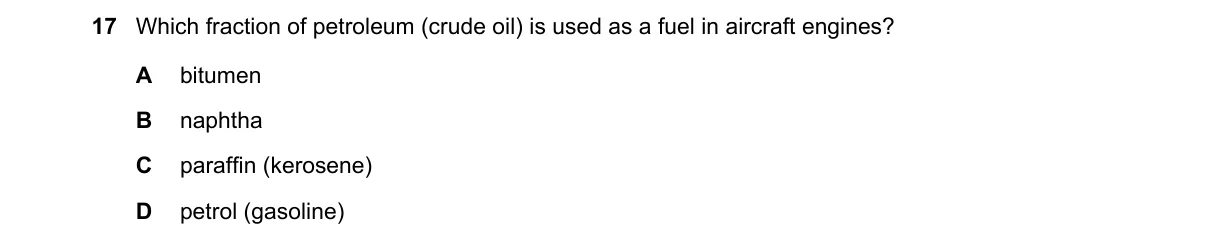
Explanation
Petroleum fractions and their uses in fuels
Steps:
- Recall that crude oil is separated into fractions by boiling point during distillation.
- Identify aviation fuel as requiring a mid-range fraction with high energy density and low volatility.
- Match fractions: petrol for cars (low boiling), naphtha for solvents (very low), kerosene/paraffins for jets (medium boiling).
- Confirm kerosene, mainly paraffins, powers aircraft engines safely.
Why C is correct:
- Paraffins (or kerosene fraction) are straight-chain hydrocarbons with boiling points of 150–275°C, ideal for jet fuel per aviation standards like ASTM D1655 for stability and ignition.
Why the others are wrong:
- A. blumen: Not a recognized petroleum fraction; likely a misspelling without fuel application.
- B. naphtha: Light fraction (boiling <150°C) used for petrochemicals, not engines due to high volatility.
- D. petrol (gasoline): Low-boiling fraction for spark-ignition engines, too flammable and low-energy for aircraft.
Final answer: C
Topic: Fuels
Practice more O Levels Chemistry (5070) questions on mMCQ.me