O Levels Chemistry (5070)•5070/11/M/J/18
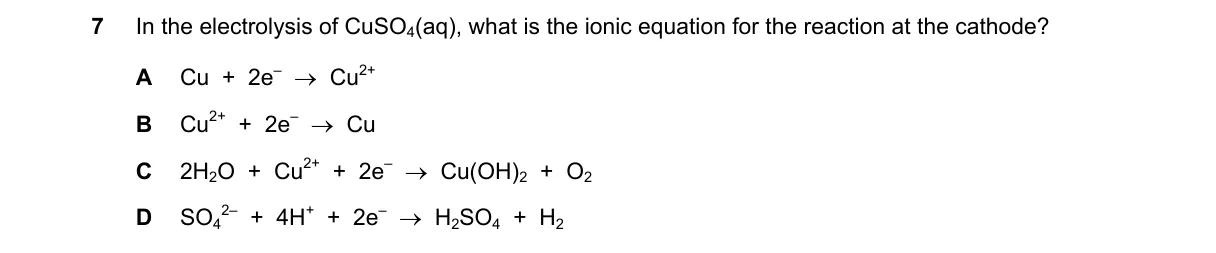
Explanation
Cathode reduction in aqueous CuSO₄ electrolysis
Steps:
- Cathode involves reduction of cations or water.
- Possible reactions: Cu²⁺ to Cu or H₂O to H₂/OH⁻.
- Cu²⁺ has higher standard reduction potential (+0.34 V) than H⁺/H₂ (0 V).
- Thus, Cu²⁺ discharges preferentially: Cu²⁺ + 2e⁻ → Cu.
Why A is correct:
- Cu²⁺ ions reduce to Cu metal as copper's electrode potential exceeds that of hydrogen, per electrochemical series rules.
Why the others are wrong:
- B: Applies to cations harder to reduce than H⁺ (e.g., Na⁺), not Cu²⁺.
- C: Oxidation reaction for anode oxygen evolution, not cathode reduction; O²⁻ absent in solution.
- D: SO₄²⁻ not reduced at cathode; equation violates standard electrochemistry.
Final answer: A
Topic: Electrolysis
Practice more O Levels Chemistry (5070) questions on mMCQ.me