O Levels Physics (5054)•5054/12/O/N/21
Explanation
Centripetal Force in Uniform Circular Motion
Steps:
- Uniform circular motion at constant speed means velocity changes direction, producing centripetal acceleration toward the circle's center.
- Newton's second law states resultant force equals mass times acceleration, so it acts in the acceleration's direction.
- The track's friction or banking provides this inward force to keep the car curving.
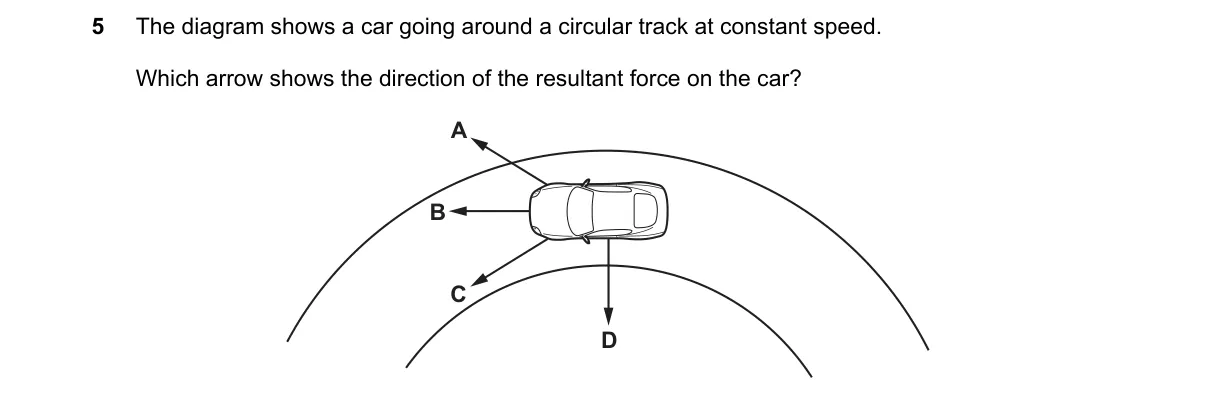
- Therefore, the resultant force direction is radially inward, toward the center.
Why D is correct:
- D points toward the center, aligning with the centripetal force formula F = mv²/r, which requires inward direction for circular path.
Why the others are wrong:
- A points tangential forward, indicating force for speeding up, not turning.
- B points radially outward, opposing the needed inward force and causing straight-line motion.
- C points tangential backward, suggesting braking force, not for direction change.
Final answer: D
Topic: Circular motion
Practice more O Levels Physics (5054) questions on mMCQ.me