O Levels Physics (5054)•5054/12/O/N/21
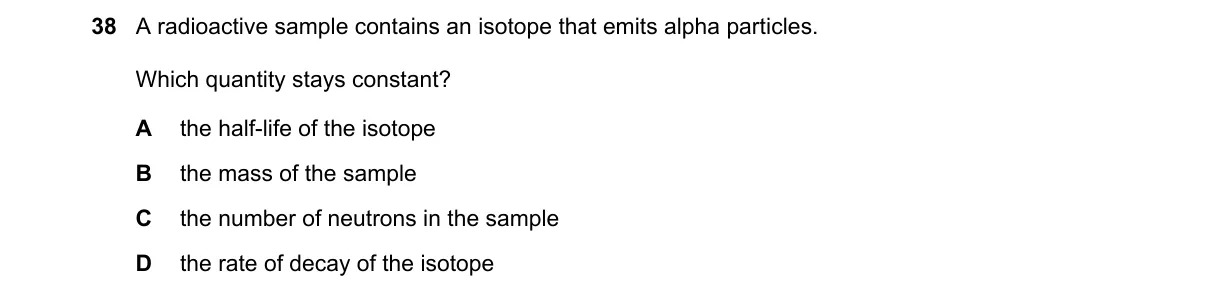
Explanation
Alpha Decay Leaves Half-Life Unchanged
Steps:
- Alpha decay emits a helium-4 nucleus (2 protons, 2 neutrons), reducing the parent nucleus's protons and neutrons by 2 each.
- This transforms the isotope into a different daughter isotope with its own properties.
- The half-life is an intrinsic property of each isotope, defined by its nuclear stability and decay constant.
- As decay proceeds, the sample's composition changes, but the original isotope's half-life remains fixed.
Why A is correct:
- Half-life is the time for half of the atoms of a specific isotope to decay, a constant determined by the decay constant λ in the formula t_{1/2} = ln(2)/λ, unchanged by the decay process itself.
Why the others are wrong:
- B: Each alpha emission removes 2 neutrons from the sample, decreasing the total number.
- C: Alpha particles carry away mass (approximately 4 u per decay), reducing the sample's overall mass.
- D: Decay rate λN decreases exponentially as N (number of undecayed atoms) drops over time.
Final answer: A
Topic: Radioactive decay
Practice more O Levels Physics (5054) questions on mMCQ.me