O Levels Physics (5054)•5054/12/O/N/20
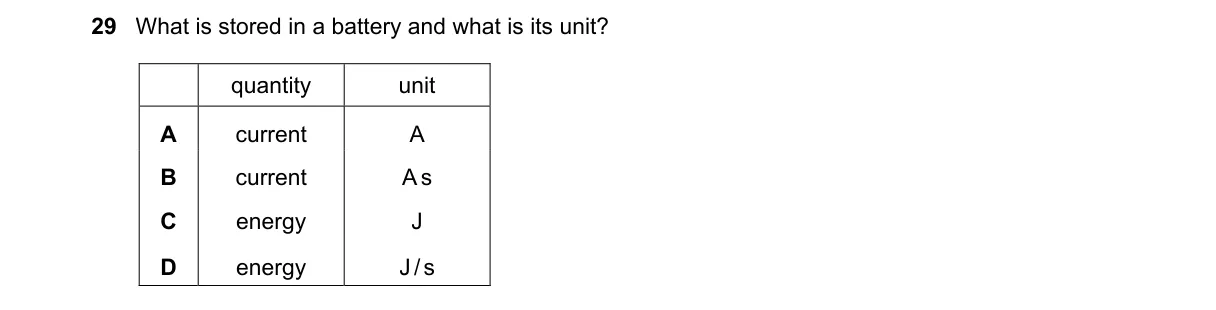
Explanation
Batteries store chemical energy, measured in joules
Steps:
- Identify what a battery does: converts stored chemical potential into electrical energy.
- Recall that electrical devices use current (flow of charge), voltage (potential difference), and power (rate of energy transfer), but storage is the energy itself.
- Note battery capacity is often in ampere-hours, but fundamentally, it holds energy equivalent to charge times voltage.
- Confirm unit: energy is in joules (J), as work done by electric fields.
Why B is correct:
- Batteries store chemical energy, released as electrical energy; the unit joule (J) measures energy per the definition of work in physics.
Why the others are wrong:
- A: Current (A) is the rate of charge flow, not what's stored—batteries provide it, but don't store it.
- C: Same as A; current isn't stored.
- D: Energy per second (J/s) is power (watts), the rate of energy delivery, not stored energy.
Final answer: B
Topic: Action and use of circuit components
Practice more O Levels Physics (5054) questions on mMCQ.me