O Levels Physics (5054)•5054/12/O/N/20
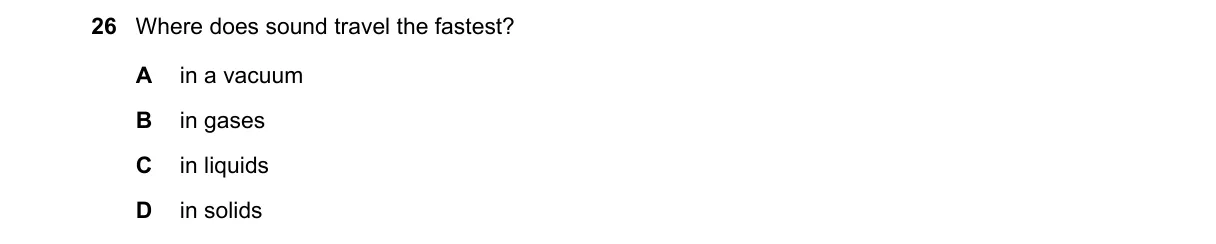
Explanation
Sound speed increases with medium density and elasticity
Steps:
- Sound waves propagate via particle vibrations, requiring a medium.
- Speed depends on how quickly particles transfer energy, influenced by density and stiffness (elasticity).
- Compare media: gases have low density/low elasticity; liquids higher density/moderate elasticity; solids highest density/high elasticity.
- Thus, solids enable fastest transmission.
Why D is correct:
- In solids, high elasticity (strong interatomic bonds) and density allow rapid particle collisions, per formula v = √(E/ρ) where E is elastic modulus and ρ is density—solids maximize this ratio.
Why the others are wrong:
- A: Vacuum lacks particles, so sound cannot propagate (speed undefined or zero).
- B: Gases have widely spaced, loosely bound particles, yielding slowest speeds (e.g., ~343 m/s in air).
- C: Liquids offer better conduction than gases but lower elasticity than solids (e.g., ~1480 m/s in water vs. ~5000 m/s in steel).
Final answer: D
Topic: Sound
Practice more O Levels Physics (5054) questions on mMCQ.me